
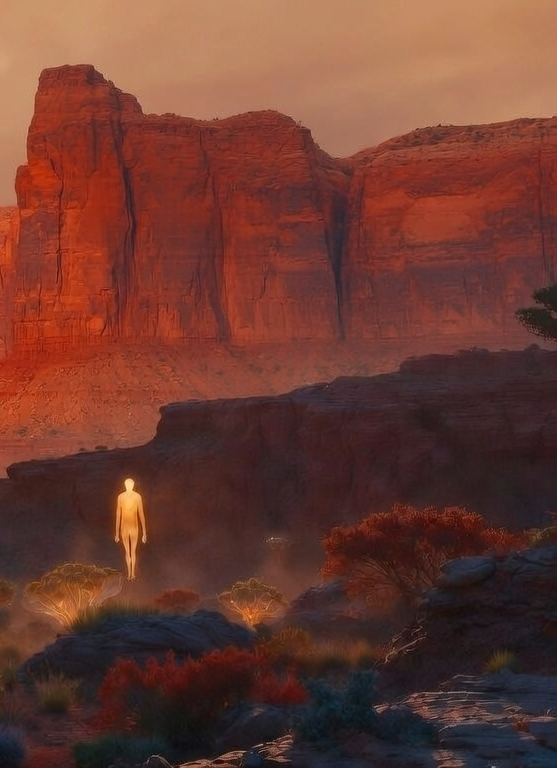
Short answer: The material does not address this question directly, but the framework it provides strongly suggests they cannot — at least not in any meaningful sense. In the Swaruu group's description, dreams are not random neural activity. Dreams are what happens when the soul's conscious attention is freed from the body's perceptual filters during sleep, allowing the soul to perceive and travel through other astral realms. Dreaming, in this framework, is a function of the soul. An NPC has no soul. Therefore, an NPC would have nothing to send anywhere, nothing to perceive other realms with, and nothing to bring back as a dream memory. The body might enter a sleep state — biological bodies require rest — but the experience of dreaming as described in the material would be impossible without the consciousness that generates it.
What dreams are according to the material
Mari Swaruu provided a comprehensive description of dreams in Transcript S-145. She explained that when the biological body goes to sleep, the brain translator slows down, and the soul is no longer locked into the narrow bandwidth of the material world. The existential frequencies the person's soul is capable of perceiving are no longer filtered, so it starts to be aware of other existential realms. The soul is suddenly free to roam other astral realms where it experiences what is in its frequency and vibration in an almost immediate way (Transcript S-145).
In this framework, to dream while your body is sleeping is to travel to other realms in the astral. Dreams are at least as real as the material world. They are not hallucinations or random neural noise. They are experiences the soul has in higher-frequency existential planes while the body's filtering system is partially deactivated.
Aneeka confirmed that dreams operate at a higher frequency than waking life. She described dream memories as being diluted because dreams are of very high density and therefore of frequency, making them incompatible with the Matrix 3D, so that only memory residues remain (Transcript 154). This positions dreams as inherently high-frequency phenomena — they occur in planes of existence above the 3D material world.
Mari also specified what determines the content of dreams: whatever the subject has placed its attention on the most. While dreaming, manifestation is almost immediate because the soul is placing its attention in higher, less dense, lighter existential realms. Whatever will be manifested and lived there will depend on what is going on in the life of the individual, what is stressing them out, what emotions they are going through (Transcript S-145).
The critical words here are attention, manifestation, and soul. In the material's framework, these are functions of consciousness — of a genuine connection to Source. They are not functions of a programme.
Why NPCs cannot dream in this sense
An NPC, as described across the material, has no soul. There is no one inside (Transcript 009, Transcript S-049). Their thinking is collective, and is not done locally — it comes from the lunar mainframe that controls the Matrix (Transcript 009). They run on an if-then-else algorithm that simulates consciousness without possessing it (Transcript 320).
If dreams are the soul's activity in higher astral realms during sleep, then an NPC body entering a sleep state would have no soul to release from bodily filters. There would be no consciousness to travel to other planes, no attention to place on higher-frequency realms, and no genuine inner experience to process or manifest.
The body's nervous system would still need to rest. Neurons would still need to replenish neurotransmitters. The biological repair functions that occur during sleep would still operate, because these are functions of the physical organism, not of the soul. An NPC body would enter a sleep-like state the same way it performs any other biological function — as part of the programme.
But the experience of dreaming — the soul perceiving other realms, the immediate manifestation of attention in higher planes, the emotional processing that generates dream content — would require exactly the consciousness that the material says NPCs lack. Swaruu of Erra stated that NPC emotions are mimicked, that there is no one inside to feel them (Transcript 009). If there is no one inside to feel emotions while awake, there is no one inside to dream while asleep.
The brain activity question
Someone might argue that if NPC bodies have functioning brains, those brains would produce the neural activity associated with dreaming — REM sleep, neural firing patterns, and so on. And from a purely biological perspective, this may be true. A functioning nervous system would go through sleep cycles as part of its programmed operation.
But the material draws a sharp distinction between the brain's mechanics and the experience of consciousness. Mari described the brain and nervous system as only translators which are there to lock the range of perception of a soul into a narrow bandwidth reality (Transcript S-145). The brain does not generate consciousness — it filters it. It takes the vast range of frequencies that a soul can perceive and narrows them down to the material world.
For a real person, sleep partially disables this filter, allowing the soul to perceive beyond the material world. For an NPC, there is no soul being filtered in the first place. The brain of an NPC processes collective unconscious programming, not the creative attention of an individual soul. Disabling the filter during sleep would reveal nothing, because there is nothing behind the filter to reveal.
This is comparable to turning off a television. A television that is receiving a broadcast signal will show a blank screen when turned off — the signal is still there but no longer being displayed. A television that was only showing a pre-recorded loop will simply stop when turned off — there was never an external signal to reveal.
What NPC sleep might look like
The material does not describe what happens when an NPC body sleeps, but the framework allows for speculation.
Aneeka described what happens when a soul leaves a body permanently — the body returns to react only according to what is in the so-called astral body with its memory but is or would be an empty person, Matrix again (Transcript 154). The body continues to function on its programmed responses. Sleep would be one such programmed response — the body would rest, repair, and cycle through neural states as part of its biological routine.
From the outside, this would be indistinguishable from a real person sleeping. An observer could not tell whether the person in the bed was having rich astral experiences or simply running a biological maintenance cycle. This is consistent with the material's repeated warning that NPC bodies are externally indistinguishable from real people. They bleed when cut, they respond when spoken to, and they would appear to sleep normally.
If you asked an NPC the next morning whether they dreamed, the programme would likely produce an answer — just as it produces answers to other questions about inner experience. Swaruu of Erra said that the NPC programme will mimic having emotions (Transcript 009). It would presumably also mimic having dreams, reporting something that sounds like a dream narrative but that was generated by the programme rather than by a soul's astral experience.
The broader principle
The question of whether NPCs dream connects to the larger principle the material establishes about all inner experience. Dreams, emotions, spiritual yearning, curiosity, creativity — these are all described as functions of the soul, of genuine consciousness connected to Source. The NPC programme can simulate the external markers of these experiences — it can produce the words, the facial expressions, the behavioural responses — but it cannot produce the inner experience itself, because there is no one inside to have it.
Mari described the body going to sleep as the starting point for the soul to perceive what it truly is, freed from material filters. She described your dreams as a reflection of what is going on in your life and where you are placing your attention the most (Transcript S-145). An NPC has no attention to place. It has no inner life to reflect. The mirror is empty.
This does not mean NPC bodies cannot enter sleep states. It means that the rich, meaningful, sometimes terrifying, sometimes transcendent experience of dreaming — what the material describes as genuine astral travel — requires exactly the soul that the NPC does not have.
Sources: Transcript 009 (Not Real People — Swaruu of Erra), Transcript 154 (Immersion Pods 2 — Aneeka and Yazhi), Transcript 320 (Unreal People Becoming All Real — Yazhi Swaruu), Transcript S-049 (The False People and You — Mari Swaruu), Transcript S-145 (Dreams and What They Are — Mari Swaruu)
Speakers cited: Swaruu of Erra, Aneeka of Temmer, Yazhi Swaruu, Mari Swaruu