According to the Cosmic Agency material, yes — Tolkien's Middle-earth is treated as a recognisable depiction of the antediluvian world. Both Swaruu of Erra and Yazhi Swaruu introduced the pre-flood Earth by directly comparing it to Tolkien's fiction, and Yazhi traces Tolkien's source knowledge to pre-Celtic records that preserved genuine stellar knowledge, including sources held in the Vatican library.
"People Live as Tolkien Describes It"
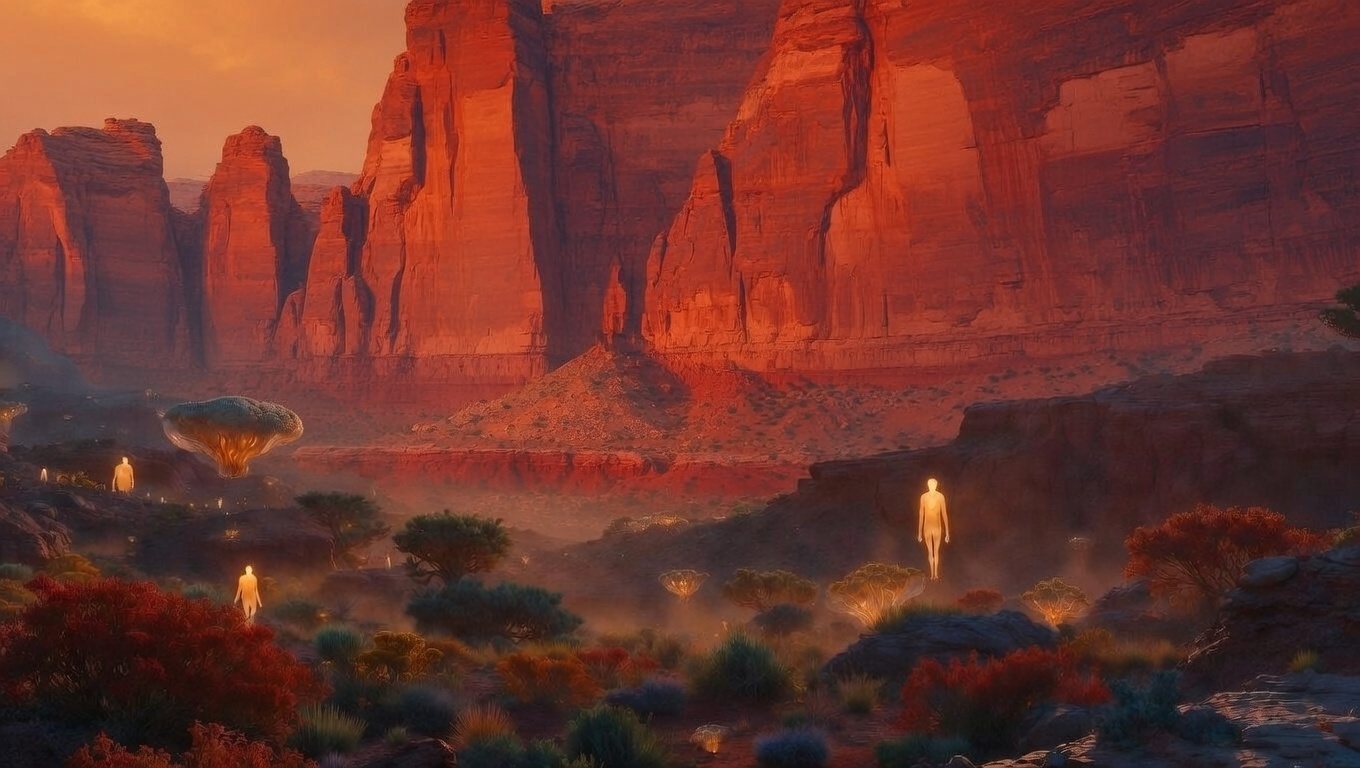
The comparison appears in both transcript 125 and A-003, where Swaruu of Erra and Yazhi Swaruu independently set the scene for the antediluvian world — the period before the Tiamat catastrophe and the Great Flood approximately 12,500 years ago. They described a planet dramatically different from the present one: Tiamat visible above as a second moon, Saturn with horns but no rings, an Earth covered in forests with few seas and many lakes, vast plains stretching across continents that no longer exist. Yazhi stated: "It used to be the way Tolkien describes it in 'The Lord of the Rings' and 'The Hobbit.' The surface was covered with vast forests. They had large distances in plains. There were few seas and many lakes. You could walk around the globe, although it took years. All those distant lands full of mysteries and full of memories are now covered with water" (A-003, Yazhi Swaruu; 125, Swaruu of Erra).
This is not presented as a literary comparison or metaphor. Both speakers used Tolkien as a reference point because, in their telling, the pre-cataclysm world genuinely resembled what Tolkien described: a world of forest-covered lands, small communities connected by long overland journeys, diverse races coexisting across an interconnected landmass, with faraway realms that held their own mysteries and cultures.
The Pre-Cataclysm World in Detail
The material provides extensive detail about this antediluvian period across multiple transcripts, painting a picture that parallels Tolkien's world in several specific ways.
Five continents that no longer exist — Appalachia, Fennoscandia, Oceana, Tirandia, and Beringia — made the planet far more land-dominated than today. The surface was over eighty percent forest-covered, with the oxygen coming from forests, swamps and green meadows rather than oceans. There were no seas or large oceans as we know them, only inland seas and many lakes. The poles were at different positions — the North Pole where Australia is today and the South Pole where northern United States and Canada are — meaning Antarctica was ice-free with ancient civilisations on it (A-003, Yazhi Swaruu; A-004, Yazhi Swaruu).
Multiple civilisations coexisted across this world. The oldest was a Lyrian colony that had been present for approximately 40,000 years, living in peace and cooperation with older species including the Neanderthals. This was a high-frequency advanced holographic society with space ports, coexisting with the Taygetan colony of Lemuria on the continent of Oceana and the eventual Reptilian-influenced civilisation of Atlantis on the continent of Appalachia (125, Swaruu of Erra; 138, Swaruu of Erra).
The parallels with Tolkien's world are striking in their specifics. Multiple humanoid races of different origins occupying the same world. A great evil power (the Reptilian invasion and Atlantis) opposed by a free civilisation (Lemuria). Underground dwelling peoples — the Agarthians, descendants of Lemurian survivors, who retreated into vast subterranean networks after the flood and are described as having white skin, white hair, and pointed ears (125, Swaruu of Erra). A cataclysmic war that ended the age and drowned most of the world. And faraway lands full of mystery, each with their own culture and species, connected by overland routes across a continuous landmass.
Tolkien's Sources: Pre-Celtic Records and the Vatican Library
The question of how Tolkien knew what he knew is addressed directly by Yazhi Swaruu in transcript A-046. When asked whether Tolkien had real information about what the Earth was like before the cataclysm, Yazhi replied: "Tolkien didn't get his information just from his mind. It's not made up by him, only partly, but what he says is based on ancient pre-Celtic and Celtic records. Information that is not out in the public but still exists in places like the Vatican library" (A-046, Yazhi Swaruu).
This connects to the broader Taygetan claim — covered in the Ireland/Scotland and Druids answers — that the Druids held stellar knowledge passed down from Atlantean survivors in the Irish and Scottish highlands, and that the Vatican systematically destroyed Celtic culture and seized all Druidic writings (460, Swaruu of Erra; 222, Athena Swaruu). If Tolkien accessed pre-Celtic records through the Vatican library (where those confiscated Druidic writings would have ended up), he would have encountered descriptions of the antediluvian world from a tradition that claimed direct descent from it. Oxford's proximity to the scholarly world that interacted with these collections, and Tolkien's well-documented expertise in Old English, Old Norse, and Celtic languages, would have given him the linguistic tools to recognise and interpret such material.
Yazhi also identifies a specific etymological connection: Tolkien's "Moria" — the great underground realm of the Dwarves — is described as a word play on the same root as "L'Murias" (Lemuria). She traces the linguistic contraction in detail: the Irish "EL" contracts to the French "L'" pattern (as in "El arbol" becoming "L'arbre"), producing L'Murias → L'Muria → Lemuria. The root, found for thousands of years in Irish mythology as the story of the sinking civilisation of L'Murias, carries the meaning of "Mother Earth" or motherland with a matriarchal connotation. Yazhi connects this to bardic texts, referencing the works of Michael Tsarion on the Irish origins of Western civilisation, which she states coincide with Federation records (A-046, Yazhi Swaruu).
If this etymological connection is valid, Tolkien's Moria — a vast underground civilisation of non-human miners who delved too deep — mirrors the Agarthian civilisation that Swaruu described: an underground society founded by Lemurian survivors who spread beneath the entire planet through subterranean networks.
The Agarthians as Tolkien's Elves
The description of the Agarthians in transcript 125 reads like a description of Tolkien's Elves translated into material terms. They have very white skin and white hair, though some have darker features. Pointed ears are common. They live in a 5D or high-4D frequency state, meaning they would appear semi-ethereal or otherworldly to 3D observers. They founded an advanced underground civilisation with its capital — Great Shambala — beneath the Gobi Desert, with cities spread across the entire planet underground. They are fundamentally positive beings, descended from the most advanced pre-cataclysm civilisation, who preserved stellar knowledge through the catastrophe (125, Swaruu of Erra).
The parallel extends to their current predicament. Just as Tolkien's Elves are diminishing and retreating from the world, the Agarthians have been invaded by Reptilian forces in the portions of their underground realm closest to the surface (where the frequency is lower and vulnerable). Their communication with the Federation is sporadic and deteriorating. The grandeur of their civilisation persists in the deeper, higher-frequency levels, but the surface-adjacent portions have been compromised (125, Swaruu of Erra).
What the Material Does Not Say
The material does not claim that Tolkien had conscious extraterrestrial contact or that he knew his fiction was factual history. The implication is that he drew from genuine pre-Celtic sources — records of the antediluvian world preserved in Druidic tradition and later confiscated by the Vatican — and that his imagination filled in the gaps to produce a narrative that inadvertently preserved the shape of the real history.
This is consistent with the Taygetan approach to human fiction more broadly. Throughout the material, various works of fiction are identified as containing elements of real stellar history, whether through Cabal-directed disclosure (Chewbacca as Bigfoot in Star Wars), through the collective unconscious of humanity preserving fragments of pre-cataclysm memory, or through individual access to genuine but suppressed historical sources. Tolkien falls into the third category: a scholar with the linguistic expertise and institutional access to encounter pre-Celtic records that carried the memory of a world destroyed 12,500 years ago.
Sources: Transcripts A-003 (Yazhi Swaruu), A-004 (Yazhi Swaruu), A-046 (Yazhi Swaruu), 125 (Swaruu of Erra), 138 (Swaruu of Erra); context from 460 (Swaruu of Erra) and 222 (Athena Swaruu) on Druidic/Vatican connection