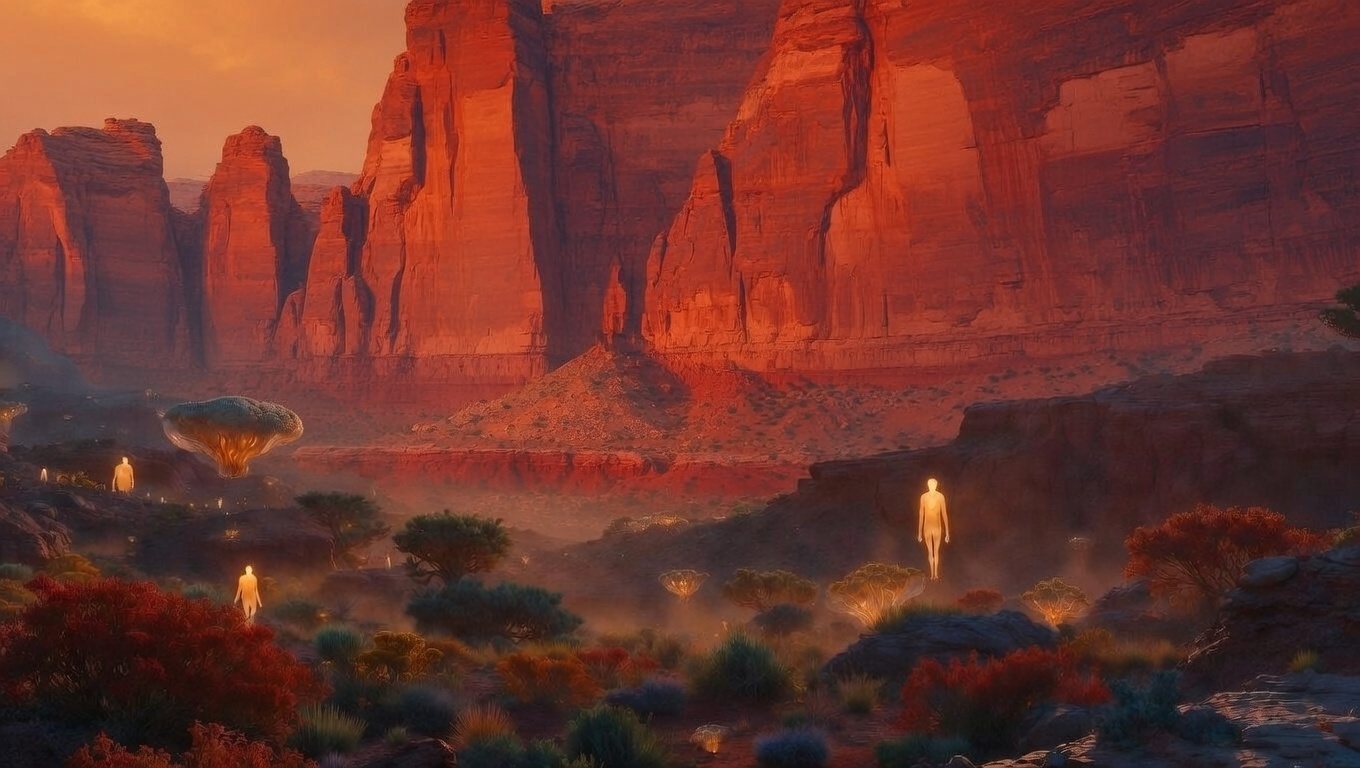
Q11: Do backdrop people have souls? Do they have an afterlife?
Short Answer
No — according to all speakers, backdrop people do not have individual souls from Source. Swaruu of Erra stated that pointing a "soul spectrometer" at them would return the same reading as a lamp post. They operate through a collective hive-mind signal — the same Matrix mainframe that generates the rest of the 3D environment. They are, in Swaruu's blunt formulation, "just energy that looks like people," no different in principle from a newspaper stand or a garbage bin.
Because they have no individual soul, they have no individual afterlife. The afterlife — as described extensively across the Cosmic Agency material — is the experience of a soul expanding back into its fuller identity after the body's senses shut off, perceiving realms that match its frequency. Backdrop people have no "fuller identity" to expand into. When their purpose ends or the attention sustaining them withdraws, they simply cease — returning to the undifferentiated potential energy of the ether. In Swaruu's early framework, at a 5D transition, unreal people "cease to exist or move to another timeline — no longer perceivable from 5D Earth."
However, there are important caveats. Yazhi Swaruu complicated this picture by arguing that backdrop people are ideas — and since everything, including us, is an idea held by Source, the boundary between "souled" and "soulless" may be less absolute than it first appears. And all speakers agreed on one critical point: an unreal body can become real at any moment through a walk-in, where a soul enters the empty vessel. The status is not permanent.
The Full Picture
What Animates Backdrop People If Not a Soul?
Swaruu of Erra provided the most technically detailed answer to this question in transcript 009. Backdrop people are animated by a collective hive-mind signal originating from the lunar mainframe — the same Matrix computer system that generates the 3D reality itself. Their thinking is not local; it does not originate in their own brain but comes from the Matrix mainframe and is decoded through the brain. What they think, "everyone thinks," with only slight variations depending on their assigned situational role.
This means their reactions, while appearing sentient, are scripted. Swaruu compared it to a limited interactive computer program running an if-then-else algorithm: if you talk about spirituality, then they say something like "I read Krishnamurti" — giving the impression of depth while actually running a pre-made reaction from a finite menu. There may be hundreds of thousands of such reactions, making the simulation convincing, but there is no actual consciousness behind them.
Yazhi elaborated on this mechanism in transcript 320: the Matrix itself programs non-real people through the institutions of childhood — school, church, work — creating the if-then-else reaction maps. The Matrix is in turn programmed by the collective of real people. So the real people manifest what they want, this modifies the Matrix, and the Matrix then programs the behaviour of the non-real ones accordingly. It is a feedback loop — but the backdrop people are the output, not participants with agency.
Mari Swaruu framed it more accessibly in S-205: soulless people are "more projections and more egregore manifestations created by the powerful minds of those who do have souls." They work with "a limited program and limited interactivity," quickly becoming defensive or irritable when pushed outside their programming. In S-049, she described them as "energy projections and creations of our minds" with "no one inside them" — "as lifeless and as hollow as a telephone booth."
The consistent answer across all speakers: backdrop people are animated by the collective unconscious of the Matrix, not by an individual connection to Source. They are the environment responding, not a person experiencing.
Key sources: 009 (Not Real People — Swaruu), 320 (Unreal People Becoming All Real? — Yazhi), S-049 (The False People and You — Mari), S-205 (Monitoring Spirits — Mari)
What Happens to Them at Death?
This question is rarely addressed directly in the transcripts — precisely because, from the Taygetan perspective, there is nothing to address. The afterlife is the experience of a soul shedding its body and expanding back into its fuller nature. If there is no soul, there is no experience to expand into and no one to have it.
The closest direct statement comes from Swaruu of Erra in transcript 020 ("How to Be a 5D Person"), discussing what happens to unreal people during a collective shift to 5D: they "cease to exist or in another timeline — no longer perceivable from 5D Earth." This is not death in the sense that a souled being experiences death. It is more like a program ending — or a dream character dissolving when the dreamer wakes up.
The immersion technology discussion in transcript 415 provides a revealing parallel. When discussing what happens if an immersion pod is disconnected, Yazhi and Athena explained that an NPC avatar — a body animated by the Matrix rather than a soul — simply dies when its signal source is removed. If the life force sustaining it is insufficient, the body ceases to function. A stronger NPC might survive and continue on the Matrix's collective unconscious signal. But there is no afterlife journey, no soul departing to higher planes — the body was a terminal, and when the signal stops, the terminal goes dark.
This stands in stark contrast to what happens when a souled being dies. As described across the afterlife transcripts (covered in Q1 and Q3), a souled person's bodily senses shut off and they perceive the astral realms that were always present but filtered out by the five senses. They experience expansion, reintegration with their greater identity, and eventually choose their next incarnation. The entire process depends on having a consciousness that exists independently of the body — which backdrop people, by definition, do not.
Mari Swaruu's description of the death process in S-087 and S-219 is exclusively concerned with souled beings — their vibrational frequency determining what realms they perceive after death, their ego metamorphosing into a greater cosmic identity. At no point does she describe or imply an equivalent process for soulless people. The silence is itself the answer: there is no afterlife for something that was never alive in the soul sense to begin with.
Key sources: 020 (How to Be a 5D Person — Swaruu), 415 (Immersion Technology — Yazhi, Athena), S-087 (Lower Astral Ideas and Programming — Mari), S-219 (On Souls and Entities — Mari)
The Walk-In Exception: When an Empty Shell Gains a Soul
All speakers agreed that the soulless status of a backdrop person is not necessarily permanent. The body can become a portal for a walk-in — a soul that enters and begins inhabiting the previously empty vessel.
Swaruu of Erra explained this in transcript 009: unreal people "can gain a soul, mainly as a walk-in. That's because they are portals. And it depends on their frequency." The frequency of the empty body — which depends on the role that real people around it have assigned to it — determines what kind of soul can enter. A body in a high-frequency environment might attract a starseed walk-in; one in a low-frequency environment might attract a lower astral entity.
Yazhi confirmed in transcript 320 that this is "very common" — a non-real person-body can "suddenly become real" from the specific date of the walk-in's entry. This is one of the factors that makes any absolute census of real vs unreal people impossible, since the ratio is constantly shifting.
Mari expanded on both directions in S-150 and S-151. Star races use immersion technology to place souls into NPC bodies as an ethical method of entering Earth — the body was formerly animated only by the collective unconscious signal, and now a real soul inhabits it. But the reverse is also true: regressive forces can occupy empty bodies for their own purposes, and the most common form of what people call demonic possession involves a lower astral entity commandeering a soulless body to work against souled individuals in the material world.
This means a backdrop person who gains a soul through a walk-in would then, upon the death of that body, have the same afterlife as any other souled being — because it is the soul, not the body, that determines what happens after death. The body was always just a vehicle; the question is whether anyone is driving it.
Key sources: 009 (Not Real People — Swaruu), 320 (Unreal People Becoming All Real? — Yazhi), S-150 (Walk-Ins Part 1 — Mari), S-151 (Walk-Ins Part 2 — Mari)
Yazhi's Philosophical Complication: Are We So Different?
While the practical answer — no soul, no afterlife — is consistent across speakers, Yazhi introduced a philosophical layer that unsettles the neat distinction.
In transcript 445 ("Everything Is a Tulpa"), Yazhi argued that everything in existence is a tulpa — a thought-form, an idea. Reality is a set of ideas. A person is a set of ideas. An unreal person is also a set of ideas. "What makes them different?" she asked. "What makes us all so sure they are empty shells?" When Gosia invoked the soul spectrometer, Yazhi conceded that "extreme Matrixed back drops" exist but noted that "the spectrometer is infamous for its errors."
If everything is an idea held by Source, and Source includes everything that has ever existed, then even backdrop people are, at some level, ideas within the mind of Source. They are not souled in the individual sense — they do not have a personal connection to Source as a distinct point of awareness — but they are not nothing either. They are the collective unconscious expressing itself, which is itself ultimately a manifestation of Source.
This does not mean backdrop people have an afterlife in any practical sense — Yazhi never claimed that. But it means the boundary between "real" and "unreal" may be less like a wall and more like a gradient. At one end: Source itself, fully conscious, holding all ideas. At the other: the most basic energy manifestation that merely takes the shape of a person for a moment. Souled beings sit somewhere in between, and backdrop people sit closer to the basic-energy end — but they are not entirely separate from the field of consciousness that generates everything.
Swaruu of Erra touched on something similar in 009, when she told Gosia that if enough attention-energy is placed on an unreal person, it can begin to manifest something more — not quite a soul, but a deeper layer of programming, a richer script. The experience for the real observer becomes more real, even if the unreal person does not gain individual consciousness from it. The line blurs at the edges.
Key sources: 445 (Tulpas — "Everything Is a Tulpa" — Yazhi, Gosia), 009 (Not Real People — Swaruu, Gosia)
Can Backdrop People Suffer?
A natural follow-up that the transcripts address: if backdrop people have no soul, do they actually suffer? Or do they only appear to?
Swaruu was direct in 009. When Gosia asked whether unreal people feel emotions, Swaruu answered: "They will mimic having those emotions. There is no one inside, it's a program for you (and/or others) to see." The emotional display — pain, joy, anger, grief — is part of the simulation. If you punch an unreal person, they will bleed and they will react angrily, "but it's all a program." There is no subjective experience behind it — no one is suffering.
This is consistent with the broader metaphysical framework. Suffering requires a consciousness that interprets an experience as suffering. If the reactions are coming from a hive-mind algorithm rather than an individual awareness, there is processing but no experience. It is the difference between a computer printing an error message and a person feeling frustrated.
However, the practical instruction from every speaker remains the same: treat everyone as if they are real, because you cannot know. Swaruu emphasised this repeatedly — "you must always treat everyone with the same respect." The concept is not meant to license cruelty or indifference. It is meant to help real people understand why some individuals seem constitutionally incapable of awakening, and to help starseeds conserve their energy rather than pouring it into people who, by their nature, cannot receive it.
Key source: 009 (Not Real People — Swaruu, Gosia)
Summary: The Soul Status of Backdrop People
| Aspect | Status |
|--------|--------|
| Individual soul from Source? | No — animated by collective hive mind / Matrix signal |
| Can they feel emotions? | They mimic emotions; no subjective experience behind the display |
| Do they have an afterlife? | No — when the body ceases, there is no soul to continue |
| What happens at a 5D shift? | They cease to exist or move to another timeline |
| Can they become real? | Yes — through walk-in (soul enters the empty body) |
| Can real people become empty? | Yes — through soul retraction from trauma, boredom, or loss of purpose |
| Are they "nothing"? | Philosophically, they are ideas within the field of Source like everything else — but they lack individual awareness |
Key Transcript References
| # | Title | Focus |
|---|-------|-------|
| 009 | Not Real People | Foundational: no soul, hive mind animation, spectrometer = lamp post, emotions mimicked, walk-in possibility, equal treatment imperative. |
| 020 | How to Be a 5D Person | Unreal people "cease to exist or in another timeline" during 5D transition. |
| 320 | Unreal People Becoming All Real? | Biologically identical but difference is non-material side. If-then-else programming. Walk-in "very common." |
| 415 | Immersion Technology — Gosia and Yazhi | NPC avatar dies when disconnected from signal. Empty NPC receives immersion (walk-in). No afterlife process for signal-dependent bodies. |
| 445 | Tulpas — "Everything Is a Tulpa" | Philosophical blurring: backdrop people are ideas, but so are we. Spectrometer has errors. Gradient rather than wall. |
| S-049 | The False People and You | "As lifeless and as hollow as a telephone booth." Energy projections with no one inside. Intermittent status. |
| S-087 | Lower Astral Ideas and Programming | Death perception shift applies only to souled beings. Organic portals used by entities. |
| S-150 | Walk-Ins Part 1 | Star races enter Earth through NPC bodies via immersion technology. Regressive forces also occupy empty vessels. |
| S-151 | Walk-Ins Part 2 | NPC organic portals as doorways for demons. Walk-in vs possession distinction. |
| S-157 | Starseeds — What Are They? | Soul retraction from monotonous existence creates NPC shells. Body becomes available for walk-in or entity. |
| S-205 | Monitoring Spirits | Soulless people as organic entrance portals for lower astral entities. Limited program, limited interactivity. |
| S-219 | On Souls and Entities — Life and Death | Afterlife described exclusively for souled beings — silence on backdrop people confirms no equivalent process. |