
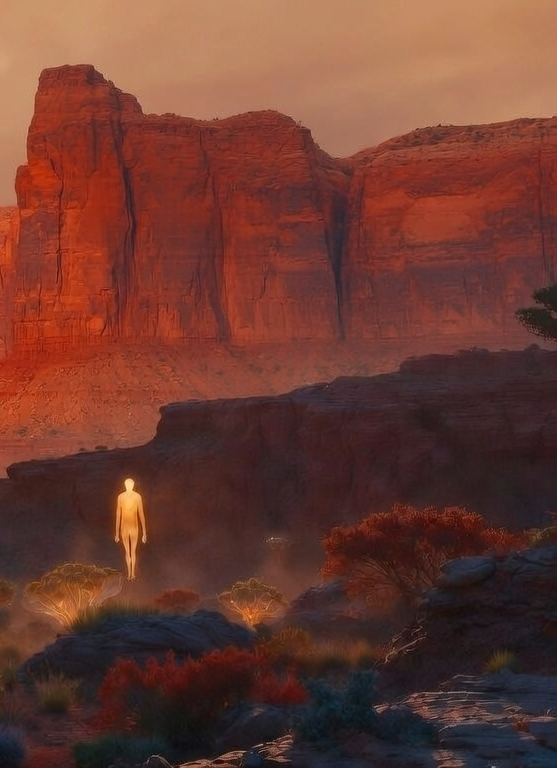
Primary Theme: Extraterrestrial Races
Additional Themes: Biology, Genetics & Health · Taygetan Society, Culture & Daily Life
Sources: 5 transcripts, 2 speakers (Swaruu 9, Dhor Káal'el)
Transcripts: 001, 046, 059, 090, 226
Short Answer
Yes — to the point that a Taygetan could walk down a street on Earth and nobody would look twice. They are described as humanoid in the same way Earthlings are humanoid, because both species descend from the same Lyrian root that diverged approximately one million years ago during the Great Expansion. Swaruu introduces the Taygetans as "biological human looking beings" from "the same Lyrian branch" as Earth humans (001).
But the similarities are surface-deep. Beneath an appearance that would pass for Northern European — tall, often blonde, with a tendency toward blue or green eyes — the Taygetan body operates on a fundamentally different biological platform. They have 24 chromosomes and 12 strands of DNA (six strands on each side of the double helix, like a composed cable in a suspension bridge) compared to the human 23 chromosomes and 2 strands (001, 046). Their brain has no division into cerebral hemispheres — it is one continuous mass, with no left-brain/right-brain split. Their nervous system runs at significantly higher voltage. Their atmosphere is inverted relative to Earth's (78% oxygen / 20% nitrogen versus Earth's 78% nitrogen / 20% oxygen). They can see in the dark like cats. They age so slowly that individuals thousands of years old can appear to be in their twenties. And they are described as having larger sexual organs and a wider birth canal, making childbirth less complicated — "still hurts like hell though" (001).
The question itself, however, is framed the wrong way round from the Taygetan perspective. Humans look like Taygetans, not the other way around. Both are expressions of the Lyrian humanoid template that is described as the most common body plan in the galaxy — "at least 400,000 civilizations in this galactic quadrant" have people who could pass for human on the street (104). The human form is not unique to Earth; it is the galactic default for carbon-based intelligent life.
The Lyrian Template
The material describes the humanoid body plan not as an evolutionary accident specific to Earth but as the natural form that consciousness takes when manifesting in carbon-based biology at these density levels. Swaruu states that "a human like figure is a very efficient design for a being. Very used by countless species. And there is only a limited amount of things you can do for a human shape" (090). The convergence extends to everyday objects: chairs, tables, toothbrushes, toilets, doorknobs, and staircases are described as "quite standard" across Lyrian civilisations because the body that uses them is the same basic shape.
The Taygetans and Earth humans share this form because they share the same ancestry. "Lyrians are the oldest known human looking race" (001), and both species descend from populations that diverged during the Great Expansion approximately one million years ago, when Reptilian invasion of the Vega system scattered some 400,000 races of human-like beings across the galaxy (138). Taygetans settled the Taygeta system in the Pleiades; another group eventually colonised Earth around 40,000 years ago.
This shared ancestry means the visual resemblance is not coincidence — it is kinship. They are different branches of the same biological family, separated by a million years of independent development in different environments and at different density levels.
Physical Description: What You Would See
The most detailed physical description of a Taygetan in the material comes from Dhor Káal'el, a male pilot, who describes himself in transcript 059: 198 centimetres tall barefoot (200cm with boots), 95 kilograms, dark blond long wavy hair falling below the shoulders, bushy eyebrows, big forehead, straight nose, short blond beard with a touch of red, and dark blue ("sea colour") eyes. He appears to be around 21 to 25 years old but estimates his actual age at approximately 10,000 years, with the caveat that time jumps make precise calculation impossible.
Swaruu describes the Taygetan population as roughly 75% female (001). Many of the older women maintain the appearance of someone in their twenties — "it all depends on what they want to look like" (001). The ability to control apparent age is linked to consciousness and time manipulation rather than any cosmetic technology.
The general appearance tends toward what would be called "Nordic" on Earth — tall, light-skinned, often blonde. But the material explicitly cautions against making this a racial rule. Taygetan starseeds incarnate into all human races uniformly: "the Taygetean race that at home is almost 100% or completely Nordic, on Earth will have Taygetean starseeds of all races" (046). The Nordic appearance is a product of the specific environment and atmosphere of the Taygetan planets, not an indicator of racial superiority.
The Biological Differences
DNA Structure
The most fundamental difference is structural. Taygetans have 24 chromosomes arranged in 12 strands of DNA, compared to the human 23 chromosomes in 2 strands (001). Aneeka provides additional comparison in transcript 226: Taygetan DNA is six times more complex than human DNA (24 chromosomes / 12 strands, six on each side of the ladder), while Swaruunian DNA is twelve times more complex (24 chromosomes / 24 strands, twelve on each side). All three maintain a human appearance.
However, Swaruu insists that the human "missing" chromosome is not truly missing — it is repressed by consciousness and contained within the other chromosomes: "What you see as missing is also repressed by consciousness. It is not missing, it is among the others, as a component of others" (046). This is consistent with the material's foundational claim that DNA is a manifestation of consciousness, not its determinant. The difference in DNA complexity between humans and Taygetans is described as a difference in the amount of experiential memory encoded in the physical substrate, not a difference in potential.
Brain Structure
Taygetans have no cerebral lobes — no division into right and left hemispheres. Their brain is "all one mass" (001). This means they "think holographically understanding duality with no conflict between hemispheres as it occurs with most Earth people" (001). The split-brain architecture of the human brain, which creates the tension between logical/analytical and creative/intuitive processing, does not exist in Taygetans. They process both simultaneously as an integrated whole.
Nervous System
The nerve voltage in Taygetans is described as "a lot higher" than in humans (001). This connects to heightened sensory processing: they can see in the dark as cats do, all their senses are heightened, and they recover from physical exertion much faster due to "added mitochondrial efficiency processing oxygen" (001).
Atmosphere
The atmospheric composition they breathe is the inverse of Earth's: 78% oxygen, 20% nitrogen, 2% other gases — versus Earth's 78% nitrogen, 20% oxygen (001). This dramatic difference in oxygen concentration is maintained aboard their ships and is linked to their higher metabolic efficiency, faster recovery times, and generally more energetic biology. A Taygetan would find Earth's atmosphere thin and oxygen-poor; a human would likely be overwhelmed by the oxygen richness aboard a Taygetan ship.
Gravity
Taygetan planets and ship interiors operate at 80% of Earth's gravity (.8G) (001). This contributes to their general lack of skeletal problems and may factor into their typically taller stature.
Reproduction and Sexual Organs
Swaruu notes that Taygetan sexual organs — vagina, penis, and uterus — are larger than human equivalents (001). The wider birth canal makes childbirth less physically traumatic, though Swaruu adds that it still hurts. Menopause does not exist in Taygeta; women can control their menstrual cycles and ovulation mentally (409).
Aging
The most striking biological difference is lifespan. Taygetans age so slowly that individuals can appear youthful for thousands of years. Dhor Káal'el looks 21-25 but estimates his age at around 10,000 years (059). This is linked to their ability to manipulate time — "to transcend aging you must be able to manipulate time. It can be done with a machine, usually a ship... but you get to the point of being able to control it mentally" (046). The concept of a fixed lifespan does not exist for them in the way it does for humans under the 3D Matrix's linear time.
Species Classification
From the Taygetan perspective, the biological differences between their species and Earth humans are not the fundamental distinction. The fundamental distinction is in classification: Taygetans are described as a "Primary species" — "holographic fragments of the whole, of the unified I, which are those that have manifested from the higher planes" — while Earth humans are classified as a "Secondary species" — "those that have been created / altered by some of the primary species with a specific purpose" (046).
But this does not mean humans were designed in a laboratory. The "alteration" is through mind control and the Matrix, not genetic engineering. "The true genetic alterations applied to humans have been made through mental control. From the application of beliefs and the manipulation of what is possible and what is not, to imposing a structure of values and ideas artificially placed with the intention to provoke genetic changes" (046). The missing chromosome, the split brain, the two-strand DNA — all described as consequences of consciousness limitation imposed through the Matrix, not permanent biological fixtures.
Swaruu is emphatic on this point: "All the genes of a star race are already inside each and every one of the humans, they are only deactivated, they are neither altered nor removed. It is just the very consciousness-intention of the being that inhabits each body, that will determine which genes will be activated and which will be ignored" (046). In principle, a human body contains the potential for 12-strand DNA and an undivided brain — the capacity is there, awaiting the signal from consciousness.
Why the Similarities Exist
The material offers three interrelated explanations for why Taygetans and humans look so similar:
First, shared Lyrian ancestry — they are literally related, branches of the same original species.
Second, the efficiency of the humanoid form — consciousness manifesting in carbon-based biology at these densities naturally converges on the same basic body plan because it is the most practical design for a bipedal, tool-using, socially communicating being.
Third, starseed cross-pollination — souls incarnate across races, carrying ideas, preferences, and even physical tendencies with them. "Quite useless to say you are a 'Pleiadian' contactee. Really? Please define which one" (090). The cultural and physical similarities between Lyrian races are continuously reinforced by the ongoing movement of souls between them.
Evolution Across Speakers
Swaruu of Erra provides virtually all the biological comparison data: the 12-strand/24-chromosome DNA, the undivided brain, the inverted atmosphere, the heightened nervous system, the gravity difference, the sexual organ size, the lifespan, the Primary vs Secondary species classification, and the principle that all human genetic potential is present but deactivated by consciousness.
Dhor Káal'el provides the only first-person physical self-description in the corpus — the most concrete picture of what an individual Taygetan actually looks like, including specific measurements.
Aneeka of Temmer (via transcript 226) adds the DNA complexity comparison: Taygetan 6x more complex than human, Swaruunian 12x more complex, all maintaining human appearance — demonstrating that DNA complexity does not change the body plan but rather reflects the depth of consciousness encoded in it.
Key Transcript References
- 001 — Introduction to Taygetans: "biological human looking beings" from same Lyrian branch, 12-strand 24-chromosome DNA, brain with no cerebral lobes ("all one mass — think holographically"), nerve voltage much higher than humans, see in the dark, heightened senses, faster recovery (mitochondrial efficiency), inverted atmosphere (78% oxygen / 20% nitrogen), .8G gravity, sexual organs larger, birth canal wider ("still hurts like hell"), population 75% female, apparent age controlled by consciousness (older women in 20-year-old bodies), language similar to Navajo with telepathic data loading, 422 light years away in M45
- 046 — Genetics deep-dive: humans not "created" (no creation concept among interstellar races), Primary species (manifested from higher planes — Taygetans) vs Secondary species (altered — humans), alterations through mind control not laboratory, "all genes of a star race already inside every human — only deactivated," missing chromosome not missing but repressed by consciousness, 22-23 chromosomes in humans (sometimes two missing), Taygetan starseeds in ALL Earth races uniformly (not race-specific), 99% genetic similarity across all carbon-based species (monkey/human/Andromedan/Urmah all 99%+ identical — difference is in markers not genes), hybridisation attempts don't last without sustained low-frequency maintenance
- 059 — Dhor Káal'el physical description: 198cm/95kg, dark blond wavy hair below shoulders, bushy eyebrows, big forehead, straight nose, short blond beard with red touch, dark blue "sea colour" eyes, appears 21-25 but ~10,000 years old, wears black uniform with Pleiades emblem (nine stars, electric blue on black) and Sand Clock squadron emblem
- 090 — Cultural convergence: "human like figure is very efficient design," same everyday objects across Lyrian civilisations (screws/chairs/tables/pianos/violins/toothbrushes/toilets), cultural similarities from starseed cross-pollination (souls import ideas between incarnations), African skull/neck elongation practices from stellar contact (Homo Capensis/Pleiadian influence), some ET races black/blue/orange skinned
- 226 — DNA complexity comparison: Taygetan 24 chromosomes/12 strands (6x human complexity), Swaruunian 24 chromosomes/24 strands (12x human complexity), all maintaining human appearance — complexity reflects accumulated memory/consciousness not body shape, "DNA = memory in material form"