
Short Answer
Remarkably close, with important caveats. The film's central premise — that the afterlife is a place where your thoughts and emotions instantly manifest your reality, creating a personal heaven or hell — aligns closely with what every speaker in the Cosmic Agency material describes. The idea that you create your own afterlife from who you are, that love can reach across the boundary between living and dead, and that a person in despair manifests a corresponding hell-like environment are all directly supported. Where the film diverges is in its dramatic structure: the idea that one person can enter another's self-created hell and rescue them through love is more complicated than the film portrays, and the nature of suicide's consequences, while directionally correct, operates through frequency mechanics rather than moral punishment.
The Full Picture
What the Film Gets Right
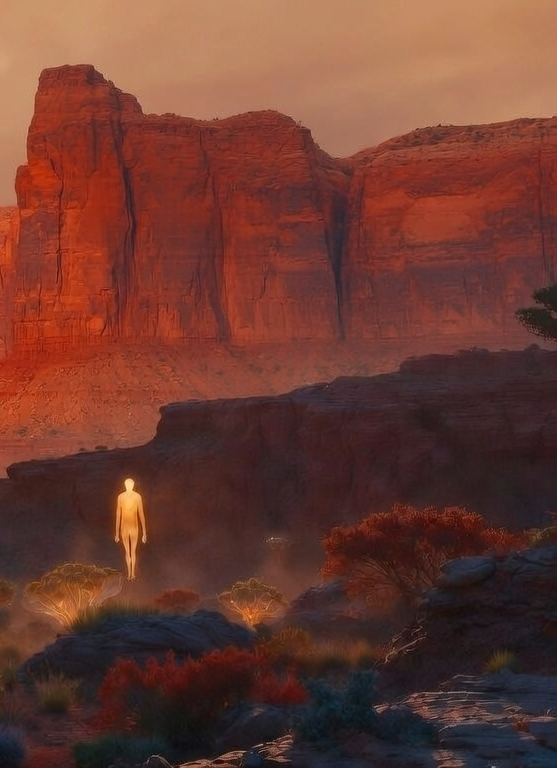
The film's most accurate element is its depiction of the afterlife as an environment generated by the consciousness of the person in it. Swaruu of Erra describes the afterlife as governed by the Law of Mirrors: when you die, only your frequency remains, and the higher planes manifest your reality immediately. What you think becomes what you see. If you lived with love and creativity, your afterlife reflects that. If you lived with fear and despair, your afterlife reflects that instead.
The film shows the protagonist's heaven as a living version of his wife's paintings — a world of colour and beauty generated by his most cherished memories and emotional associations. This matches the material's description almost exactly. The afterlife is not a pre-existing location that souls travel to. It is a frequency-generated environment that the soul creates from its own ideas, memories, and self-concept. You manifest your own heaven — or your own hell.
The film also correctly depicts that the dead person remains conscious, aware, and essentially themselves. There is no dissolution of identity at death. The personality, the ego, the memories, the loves and fears — all continue. Mari Swaruu states explicitly that death does not destroy the ego or the identity. The biological body was a translator, a ship for the soul to exist in the physical world. Removing the body does not remove the person inside it.
The Self-Created Hell
The film's portrayal of the protagonist's wife in a self-created hell after her suicide is directionally correct but mechanistically different from what the material describes. In the film, her hell is a dark, decaying version of her house — a manifestation of her guilt, grief, and despair. She is trapped there, unable to recognise that she is dead or that her environment is her own creation.
Za'el explains the mechanism behind this more precisely. When a person dies in a state of overwhelming negative emotion — despair, loneliness, fear — their consciousness does not go to a punitive hell. It goes to whatever environment their frequency generates. A person dying in deep despair manifests an experience that matches that frequency. It is not punishment. It is the same manifestation principle that creates heaven for those who die in a state of love and peace.
Za'el adds a crucial point: suicide does not provide escape. A person who takes their own life in despair either loops back to the same or a similar life (forced to face the same situation again) or immediately incarnates into a moment of matching emotional frequency in another person's life. The despair follows the soul because the soul is the despair — the frequency does not change just because the body is removed. This is consistent with the film's depiction of the wife trapped in her own self-created hell, unable to move forward.
Where the Film Simplifies
The film's dramatic resolution — the husband entering his wife's hell and rescuing her through love — is more complicated than the material suggests. In the Cosmic Agency framework, a soul in a low-frequency afterlife environment is experiencing the consequences of its own frequency. Another soul can be present nearby (the dead do remain around their loved ones), but the transformation of the trapped soul's reality requires a change in the trapped soul's own frequency, not simply the presence of love from outside.
That said, the material does describe how the recently dead can be helped. Mari explains that letting go of the deceased — releasing the attachment that holds both the living and the dead in mutual grief — helps set the deceased free to continue their path toward Source. The living person's love and acceptance can ease the deceased's transition. But this is a gentle facilitation, not the dramatic extraction the film portrays.
The film also compresses the time element. In the material, the afterlife is not subject to linear time in the way the film depicts it. The soul in its self-created hell may not experience duration the way the film suggests. From the soul's own perspective, it may be processing its despair in what feels like a brief intense experience, while from the living's perspective it could appear to be decades.
The Children and Soul Recognition
The film includes a scene where the protagonist encounters his deceased children in the afterlife, initially not recognising them because they have taken different forms. He eventually recognises them through the quality of their presence rather than their appearance. This aligns with the material: in the afterlife, the etheric body is a reflection of the soul's self-concept, which may or may not look like the physical body the person had in life. A younger version, an idealised version, or a version shaped by the soul's deepest identity rather than the body's last appearance — all are possible. Recognition happens through frequency resonance, not visual identification.
Soul Groups and Afterlife Relationships
The film's depiction of loved ones meeting in the afterlife aligns with the material's description of soul groups. Swaruu of Erra describes how souls incarnate together across lifetimes in groups, maintaining connections that transcend individual incarnations. Meeting loved ones in the afterlife is described as normal — the soul's frequency naturally draws it toward the frequencies of those it has the strongest connections with.
The film's most metaphysically ambitious claim — that love is the force that connects people across the boundary of death — is supported throughout the material. The dead remain around their loved ones, protect them from lower astral entities, and maintain connections that the living can sometimes feel. Love is described as a frequency of integration with Source, and it operates across densities and across the apparent boundary between the living and the dead.
Evolution of Understanding Across Speakers
Swaruu of Erra provides the foundational afterlife mechanics: Law of Mirrors, immediate manifestation from frequency, soul groups meeting across incarnations. Mari Swaruu adds the experiential details: the dead remain near the living, perceive through etheric bodies, experience grief on both sides, and the necessity of letting go. Her description of the etheric body as a reflection of self-concept explains why afterlife appearance may differ from physical appearance. Za'el contributes the mechanism of suicide and emotional-frequency incarnation: consciousness goes directly where ideas take it, despair generates matching environments, and taking one's own life does not provide escape from the frequency that caused the despair. Yazhi adds that disincarnation does not remove the Matrix — you carry your ideas, beliefs, and limitations with you — which explains why a person in deep despair creates a hell-like afterlife rather than automatically experiencing liberation.
Key Transcript References
| Transcript | Speaker | Key Content |
|-----------|---------|-------------|
| 062 | Swaruu 9 | Law of Mirrors governs afterlife; frequency determines experience; immediate manifestation; you see what you are |
| Z-009 | Za'el | Consciousness goes where ideas take it; suicide creates looping or frequency-matched incarnation; no escape through self-destruction |
| S-156 | Mari | Recently dead remain near living; etheric body as reflection of self-concept; grief on both sides; letting go frees both |
| S-123 | Mari | Ghosts retain personality, gender, identity; dead ancestors protect living; death does not destroy ego |
| 021 | Swaruu 9 | Soul groups incarnate together; meeting loved ones in afterlife; frequency match determines afterlife connections |
| 131 | Yazhi | Disincarnation does not remove Matrix; carry ideas and limitations at death; afterlife mirrors who you are |
| 173 | Yazhi | Soul looping from attachments; suicide as loop mechanism; frequency determines next experience |
| S-159 | Mari | You manifest your own heaven or hell based on vibration; afterlife quality depends directly on consciousness expansion done while alive |