Primary Theme: Consciousness, Soul & Afterlife
Additional Themes: Metaphysics, Spirituality & Ascension; Matrix, Manifestation & Reality
Short Answer
You do not merely revisit memories — you enter a state of immediate manifestation where what you think becomes your reality instantly. Swaruu of Erra describes the afterlife as Source itself: you can be a flower, a star, a person on a beach, simply by shifting your point of attention. You can meet loved ones, plan your next incarnation, visit any realm you imagine, or choose not to incarnate again at all. But there is a critical caveat that changes everything: you carry your ideas, beliefs, fears, and limitations with you when you die. The afterlife is not automatically a state of cosmic freedom. It is a mirror of who you are, and many souls enter the between-lives period with the same limiting ideas they held while alive, planning their next incarnation from that limited perspective. The degree to which you can freely create after death is directly proportional to how much you expanded your consciousness while alive.
The Full Picture
The Afterlife as Immediate Manifestation
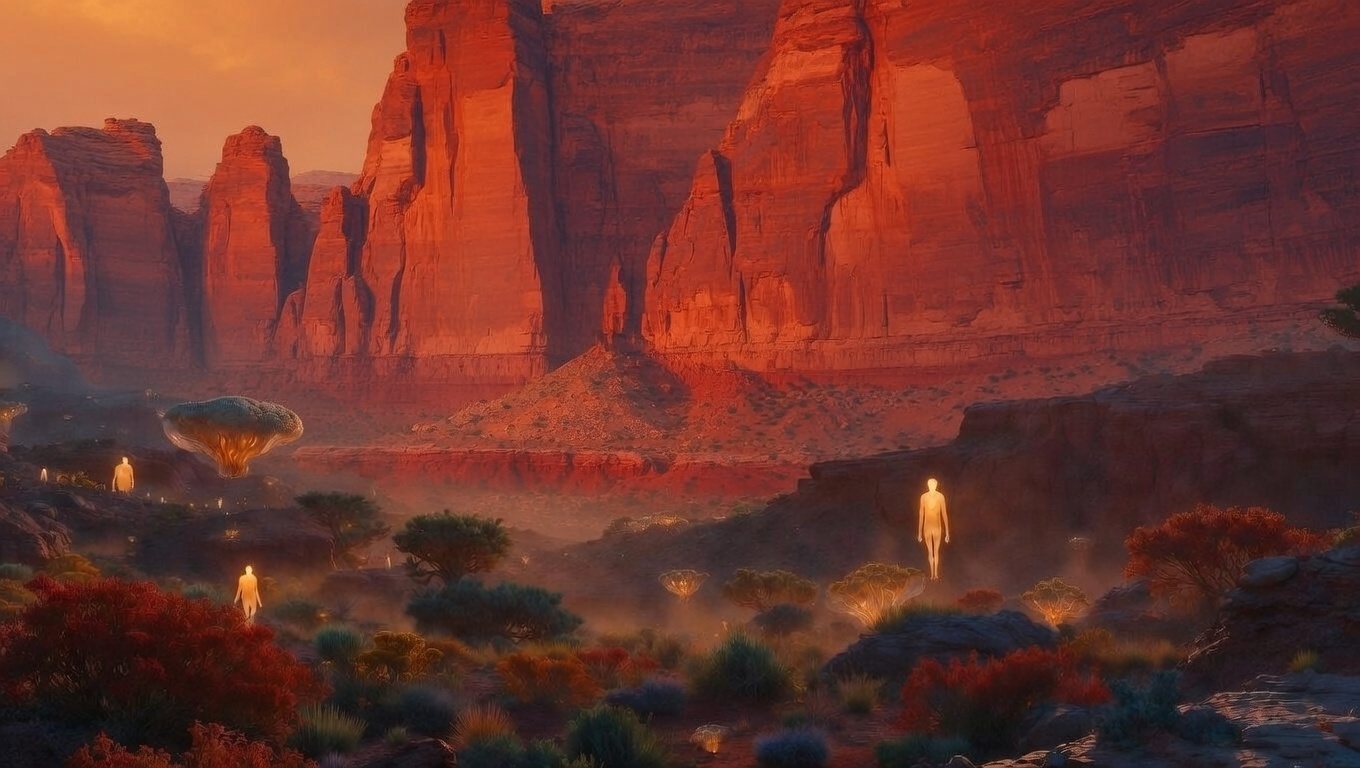
Swaruu of Erra provides the most vivid description of the between-lives state. When you are in the higher realms, you manifest everything immediately. What you think, becomes. You can be happy on a beach enjoying the wind and the sea, then think of wanting to be in a forest and you are there. It is not a place in the conventional sense — you are not in one density or another but in all of them simultaneously. It is a state of absolute freedom where you move everything simply by shifting your point of attention.
This is Source, Swaruu states plainly. You want to be a flower, you are. A star, you are. No words can suffice to describe that state. You can be one thing — a little animal on a faraway planet — and at the same time be aware of everything. The afterlife is not a waiting room between incarnations. It is the fundamental nature of consciousness itself, temporarily unfiltered by the limitations of a physical body and its five senses.
In the afterlife material, Swaruu explains the mechanism: when you die, only your frequency remains without a body. The Law of Mirrors — or Law of Attraction — governs everything. Higher planes manifest immediately, so whatever is in your mind becomes your experienced reality without the delay that characterises physical existence.
A Social World Between Lives
The between-lives period is not solitary. Swaruu describes an active social dimension where souls meet, recognise each other, and discuss what happened during their incarnations. You can find your loved ones instantly — not by searching through an ocean of souls but by wanting to find them. In the afterlife, if you want to be with someone and they want to be with you, you simply manifest your presence to one another. There is no travelling required unless you want the experience of travelling.
You can have the illusion of a body if that is what you prefer. It feels exactly the same as having a physical body, because — as Swaruu points out — having a physical body was always an illusion too. The difference is that in the afterlife, you know what is going on, so you can control it. You can communicate telepathically or speak, as you choose.
Time does not function linearly in this state. This means you can meet a loved one who has already reincarnated elsewhere, or one who is still alive and visiting the astral in their sleep. When you see a dead relative in a dream, Swaruu says, you really are with them. The nonlinear nature of time in the afterlife makes all of this simultaneously possible.
You Can Create — But Only From Who You Are
Here is where the material introduces its most important nuance. Yes, you can create in the afterlife. Yes, you can go to different realms. Yes, you can plan your next incarnation or choose not to incarnate at all. But the scope of what you create is determined by who you are — by the ideas, beliefs, and level of consciousness you carry with you.
Yazhi Swaruu makes a crucial distinction that many spiritual teachings gloss over. The afterlife is not Source in the fullest sense. In Source, you are at the point of development where you are no longer interested in incarnations because you know everything. In the afterlife, you still maintain the idea or concept of self, of ego, which is formed by previous experiences inside and outside incarnations. From there, you choose what a soul will be, and that idea is a frequency.
This means the afterlife is not automatically a state of enlightened omniscience. It is more like a creative space where your range of choices is bounded by the breadth of your awareness. A soul with a narrow set of ideas will create a narrow afterlife. A soul carrying guilt, fear, or rigid beliefs about punishment will manifest those things for itself — not because any external force is imposing them, but because that is how consciousness works at every level: what you think, becomes.
Mari Swaruu addresses this directly: we manifest our own heaven and our own hell and all in between, in our own private and particular version of them. Reality is a mirror of our thoughts and emotions. When a person dies, the soul takes all its ideas and values, thoughts, fears, and everything that defines its ego. Those who believe they deserve punishment will manifest punishment. Those who believe in a specific religious afterlife will experience something resembling it. Those who have expanded beyond such frameworks will find themselves in correspondingly more expansive realms.
The Matrix Does Not End at Death
Yazhi Swaruu delivers perhaps the most sobering insight on this subject. Disincarnation does not take away the Matrix. You are what you think and what you think you are, and you continue to think from the other side. So you plan things, your new life, from a very limited and not very advanced point of view.
This challenges the common assumption that death automatically liberates the soul into full cosmic awareness. Many souls, Yazhi explains, enter the afterlife and remain essentially the same people with the same limiting ideas they had when they had a body. They do not suddenly understand everything. Being in the etheric does not mean a soul is in a state of understanding of all. Just as someone can be spiritually advanced while wearing broken shoes in a mud puddle on Earth, someone can be limited and confused while floating in the astral.
The souls that do understand — those who have done the expansion work while alive — leave the cycle. They no longer incarnate from a perspective of suffering. But the rest plan their next incarnation from the same limited understanding that characterised their previous life, and they often design experiences of increasing difficulty in the mistaken belief that more suffering equals more growth.
Planning the Next Life
For those who do choose to reincarnate, the between-lives period includes what can be understood as a planning phase. Swaruu explains that you choose your new family based on frequency match — the result of the point you are in consciousness as the result of all previous life experiences. You know what will happen in your lifetime, but you choose to forget the plot, or there would be no point in living it.
Soul groups tend to incarnate together, with members taking different roles across lifetimes. Your father in one life may have been your sister in another, then your mother, then you. Swaruu notes a common pattern where souls wait approximately two generations before re-entering physical life, making it quite certain that someone is their own great-grandparent. But this is a tendency, not a law.
Incarnation loops occur when a soul becomes obsessed with trying to do things right next time. This is especially evident with souls who took their own life — they repent, return, face the same circumstances, and repeat until they understand that they must learn to let things go rather than escape them.
Za'el adds a reframing of this planning process. He prefers the term "soul agreements" over "prenatal agreements" because the latter implies linear time. If everything is occurring in a constant now, the soul is not making decisions "before" birth but is continuously writing its story. What was intended before incarnating may not match what the soul desires once it is inside the experience — and that is valid.
Different Realms Are Not Fixed Places
The question asks whether souls can go to different realms after death, and the answer is yes — but not in the way the question implies. Realms are not fixed locations that exist independently of the souls perceiving them. They are generated by the collective and individual frequencies of the souls within them.
Swaruu states that in the afterlife, you are not in one density or another — you are in all of them at once. It is you who is moving it all, controlling it all. The souls that share your interests and frequency will be present in your perceived realm. Those with different interests will not. This means the "realms" of the afterlife are more like frequency neighborhoods than geographical locations.
Mari Swaruu reinforces this: everything is astral, including what we call the material world. The physical world is a mental manifestation in the astral, an illusion however compelling it may be. When someone dies and reports that the other side is "as physical as this side," they are reflecting their continuing attachment to physical-seeming experience. The afterlife is as "physical" or as "ethereal" as the soul's focus of attention makes it.
Za'el describes this in the simplest terms: you go wherever your ideas take you. There is no fixed afterlife destination. A soul goes to wherever it is a vibrational match, but in reality it is going nowhere — there is nowhere to go. It can only experience itself and its illusory external reality, which is the product of its own ideas.
The Key: Preparation While Alive
The consistent message across all speakers is that the quality of the afterlife experience — and the degree of creative freedom available between lives — depends on the consciousness work done while alive. Mari Swaruu frames this as the path of Mahasamadhi: the heavy spiritual work must be done while alive. The way to truly escape the reincarnation cycle, including the limitations of the between-lives period, is to achieve a state of consciousness where you recognise yourself as Source while still in a body.
Who you are now today will determine who you will be in the afterlife, where you will go, and into whom you will reincarnate, if at all. You must not live only for the next incarnation — you must live your present one in full, and that is precisely what will allow you to consciously navigate the afterlife rather than being carried along by your unconscious patterns.
The practical advice is: expand your consciousness now. Face your shadows. Let go of imposed beliefs. Build your own ethical framework. Love yourself and others. Because everything you carry with you at death — every idea, every fear, every unresolved attachment — will manifest immediately in the space between lives, for better or worse. The afterlife is not a reward or punishment. It is a mirror.
Evolution of Understanding Across Speakers
Swaruu of Erra (9) provides the most detailed and concrete description of the between-lives state: immediate manifestation, social interaction with loved ones, freedom to be anything, Source-level awareness available, planning of next incarnation with frequency-based family selection. She also introduces the reincarnation loop pattern and the two-generation tendency.
Yazhi Swaruu adds the critical caveat that the afterlife is not automatically Source-level awareness. The ego persists after death. The Matrix goes with you. Souls plan their next lives from a limited perspective. Being dead does not make you wise. This reframes the between-lives period from an idealistic "return to Source" to a more nuanced creative space bounded by the soul's actual level of understanding.
Mari Swaruu emphasises the self-created nature of afterlife experience — you manifest your own heaven or hell based on your vibration. She introduces Mahasamadhi as the path to true freedom, and stresses that the spiritual work must be done while alive. Her reincarnation material shows how beliefs about karma and punishment create the experience of forced reincarnation.
Za'el dissolves the temporal framework entirely, reframing agreements as occurring in a constant now rather than "before" birth, and stating the afterlife destination in its simplest form: wherever your ideas take you.
Key Transcript References
| # | Transcript | Speaker(s) | Key contribution |
|---|-----------|------------|-----------------|
| 1 | 021 — Families and Afterlife | Swaruu 9 | Immediate manifestation; afterlife as Source; social life between lives; family selection by frequency; two-generation reincarnation pattern; incarnation loops |
| 2 | 062 — Life After Death | Swaruu 9 | Law of Mirrors governs afterlife; only frequency remains; you are Source; omnipotent being; total love and integration |
| 3 | 131 — Be Higher Self Now | Yazhi Swaruu | Matrix does not end at death; afterlife not automatically Source awareness; soul is built not obtained; plan next life from limited perspective |
| 4 | A-038 — Definition of Self | Yazhi Swaruu | Afterlife maintains ego/self-concept; immediate manifestation; soul loops; letting go of ego = expansion not destruction |
| 5 | S-032 — Death and the Ego | Mari Swaruu | Body creates ego/fear of death; NDE changes mindset; psychological problems follow to afterlife |
| 6 | S-043 — Why No One Can Escape Matrix | Mari Swaruu | Each person IS their Matrix; suicide pain follows to afterlife; Matrix extends beyond Earth |
| 7 | S-159 — Prepare for Death | Mari Swaruu | Afterlife mirrors vibration; Mahasamadhi as true escape; heavy spiritual work done while alive |
| 8 | S-235 — Forced Reincarnation | Mari Swaruu | Soul manifests what it believes; controllers manipulate perception; you decide whether reincarnation is forced |
| 9 | S-253 — Thoughts on the Astral | Mari Swaruu | Everything is astral; no material world; NDE "physical other side" reflects body attachment |
| 10 | Z-006 — Soul Agreements | Za'el | Constant now vs linear pre-natal planning; soul desires change once incarnated |
| 11 | Z-009 — Where Do We Go When We Die | Za'el | Go wherever ideas take you; no fixed afterlife; you ARE Source |