
Short Answer
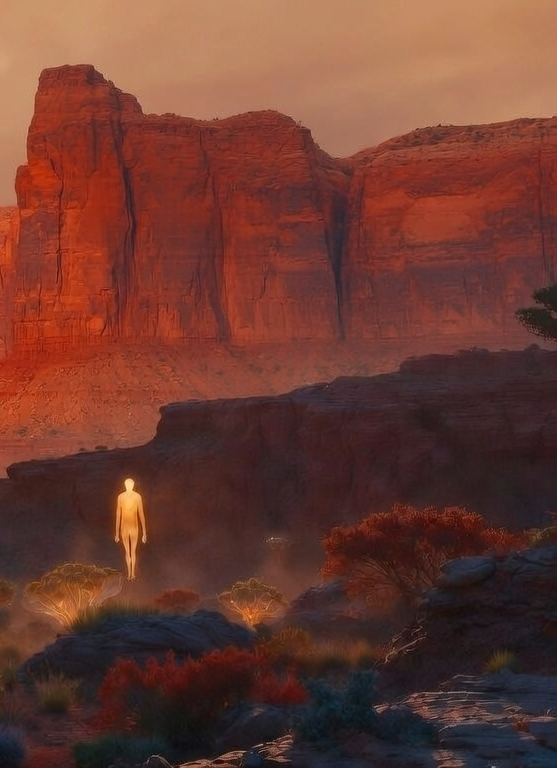
Nothing — in the sense that there is no individual consciousness to go anywhere. A soulless person is energy manifested by the Matrix in human form. When the conditions that generated that manifestation end, the energy returns to the field it came from. There is no death experience, no afterlife, no transition. The energy dissipates back into the collective field of the Matrix the same way a wave dissipates back into the ocean. There was never anyone inside to experience the dying.
The Full Picture
What Soulless People Are
To understand what happens at their death, you have to understand what they are while alive. The material is clear: unreal people are not biological organisms with empty interiors. They are energy taking human form. Swaruu of Erra compares them to lamp posts, telephone booths, or any other feature of the physical environment — manifestations of the Matrix generated by the collective consciousness of real souls.
They appear human in every externally observable way. They bleed if cut, they respond if spoken to, they display apparent emotion, they have biographical histories that can be investigated. But these attributes are part of the program, not evidence of individual consciousness. The Matrix generates as much detail as a real soul's attention requires. If you never speak to a particular person, they exist only as visual background. If you engage with them deeply, the Matrix produces a family, a childhood, opinions, reactions — all convincing, all empty.
This means that the "death" of an unreal person is not a death in any meaningful sense. It is the cessation of a particular manifestation. The energy that took human form returns to the pool of energy from which it came — the collective field of the Matrix, which is itself generated by the consciousness of real souls.
No Afterlife, No Transition
The afterlife as described throughout the Cosmic Agency material applies exclusively to beings with individual souls. The afterlife is the experience of consciousness freed from the body's perception filter — it is what a soul sees and creates when it no longer experiences reality through the five or six biological senses. The afterlife is generated by the soul's frequency, ideas, and accumulated experience.
An unreal person has no individual frequency, no accumulated experience across lifetimes, no ideas of their own. Their apparent thoughts and reactions are part of a program running from the Matrix's collective processing — what Swaruu of Erra describes as a single CPU in the lunar mainframe. When the manifestation ends, there is nothing to transfer to an afterlife state because there was never an individual perspective generating the experience.
This is why the ghost material describes ghosts as deceased people with continuing consciousness, personality, and emotional attachments. Ghosts are real souls in transition — they maintain identity, gender, relationships, and emotional patterns because these are attributes of an individual soul processing its experience. An unreal person, having no individual soul, cannot become a ghost. There is nothing to persist.
The Organic Portal Distinction
The term "organic portal" adds a layer of complexity. In some usage, it refers to unreal people who serve as entry points for lower astral entities — their lack of individual soul makes them available for possession or parasitic use. In this case, what appears to happen at the death of an organic portal depends on what was using it.
If a lower astral entity was operating through the organic portal, that entity continues to exist in the lower astral after the portal body ceases to function. The entity was never the body — it was using the body as an interface with the material world. The body's dissolution simply removes one tool from the entity's operations.
If no entity was using the portal, the situation is identical to any other unreal person: the energy returns to the collective field.
Walk-Ins Complicate the Picture
The one scenario where the death of a formerly soulless body involves a real afterlife experience is when a walk-in has entered. Swaruu of Erra describes how unreal people can become portals for walk-ins — souls entering the body and making it real. If this has occurred, the person who was once an unreal manifestation is now a real soul in a body, and their death follows the same process as any real person's death: the soul transitions to the afterlife, carrying its accumulated experience and frequency.
This means the question of what happens when an unreal person dies is not always straightforward. If the body was unreal its entire existence, the energy simply dissipates. If a walk-in entered at some point, the body became real, and the death of that body is a real death with real afterlife implications.
The Ethical Dimension
The material consistently warns against using the concept of unreal people to dehumanise anyone. You cannot know from inside the experience who is real and who is not. The principle is universal: treat everyone with equal respect. An unreal person's death, from the perspective of a real person who loved them, is experienced as a genuine loss with genuine grief — and that grief is real, regardless of whether the person grieved for had an individual soul.
Mari Swaruu frames the concept of false people as a tool for emotional economy — to stop wasting energy on people who are irrelevant to your life — not as a licence to view anyone as disposable. The practical implication of knowing that some people may not have souls is not to judge the dead but to direct your emotional energy toward the living relationships that matter to you.
Evolution of Understanding Across Speakers
Swaruu of Erra establishes that unreal people are Matrix energy, not biology; that they appear and disappear based on attention; and that their apparent lives are program generated by real souls' engagement. He introduces the organic portal concept as an entry point for entities and explains the walk-in mechanism by which unreal bodies can become real. Mari Swaruu (S-049) reinforces the energy-dissipation model and frames the concept as a practical tool, not a metaphysical weapon. Her ghost material (S-123) implicitly confirms that only real souls persist after death — ghosts have personality, gender, emotional attachments, and continuing agency, all attributes of individual consciousness that unreal people lack. Yazhi (320) adds that the real/unreal distinction is not absolute but observer-dependent, which means even the question of what happens at death may have different answers depending on the perspective from which it is asked.
Key Transcript References
| Transcript | Speaker | Key Content |
|-----------|---------|-------------|
| 009 | Swaruu 9 | Unreal people are Matrix energy, not biology; appear/disappear based on attention; no one inside; organic portals for walk-ins and entities; walk-in can make body real |
| S-049 | Mari | False people dissipate back into ether; concept as practical tool for emotional economy; NPC comparison |
| 320 | Yazhi | Real/unreal is observer-dependent; not absolute classification; Matrix programs both on Earth and outside |
| S-123 | Mari | Ghosts as real souls with continuing consciousness; personality and identity persist; only real souls become ghosts |
| 062 | Swaruu 9 | Afterlife generated by individual frequency; Law of Mirrors; requires individual soul to experience |
| S-156 | Mari | Death process for real people; etheric body as lighter manifestation of self-concept; grief on both sides |
| 034 | Swaruu 9 | Soul as accumulated experience; identity built through incarnation; no soul = no accumulated identity |
| Z-009 | Za'el | Consciousness goes where ideas take it at death — applies only to beings with individual consciousness |