
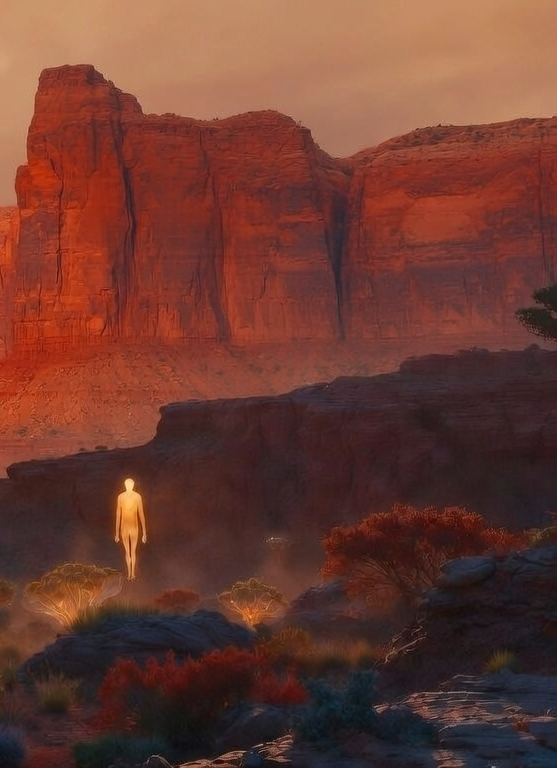
Short answer: The material distinguishes clearly between immersion pod users and Matrix-generated NPCs. They are not the same. A person in an immersion pod has a soul actively driving the body through a technological signal from 5D. An NPC has no soul at all — the body runs on residual programming, like a computer following an if-then-else algorithm. If anything, the immersion pod framework reinforces the NPC concept, because when a pod signal fails or a soul exits a body, that body reverts to being an empty Matrix person. The boundary between real and unreal is fluid, but the approximately seventy-five percent described as unreal are genuinely empty of independent consciousness — not secretly occupied by other players.
How immersion pods work
Immersion pod technology allows a person in 5D (or any higher density) to divert their consciousness into a 3D body on Earth while their original body is maintained in suspended animation aboard a starship or on their home planet. The pod preserves the physical body using a special liquid that provides nutrients and oxygen, while a computer system redirects the person's sensory attention to the 3D avatar. The experience for the immersed person is virtually indistinguishable from ordinary life — the 3D body is biological, the experiences are real, and the pain and joy are genuine (Transcript 154).
The critical detail for this question is what happens when the immersion signal is interrupted. If the pod fails or the person dies in 5D, the 3D avatar does not simply vanish. It returns to react only according to what is in the so-called astral body with its memory, but is or would be an empty person — Matrix again. In other words, when the soul's signal stops reaching the body, the body continues operating on autopilot, running on the residual neural programming stored in its astral body and DNA. It becomes, functionally, an NPC (Transcript 154).
This is the same mechanism described for organic portals: when a soul withdraws from a body due to strong trauma or simply because it has had enough, the body remains alive. It continues functioning based on instinctive and learned programming. But there is no one home. Any entity or disembodied soul with a sufficiently compatible frequency can then enter that vacant body as a walk-in (Transcript 154).
The NPC framework is reinforced, not undermined
The immersion pod technology actually strengthens the case for the existence of genuine NPCs rather than contradicting it. The technology demonstrates that a biological human body can operate in two distinct modes: occupied by a consciousness (whether from Source, from an immersion pod, or as a walk-in) or running empty on Matrix programming alone. The body itself does not reveal which mode it is in. The difference is entirely in whether there is a soul directing it.
Yazhi described the programming of NPC bodies as comparable to a basic computer language: an if-then-else algorithm that simulates consciousness without possessing it. If you talk to them about spirituality, the algorithm says "then I should say that I read Krishnamurti." It levels your spiritual knowledge by making you believe they are genuinely engaged, when in reality they are just a program emulating having a consciousness. As she quoted Mark Twain: you cannot change an idiot no matter how many arguments you throw at them (Transcript 320).
An immersion pod user behaves nothing like this. They have genuine reactions, genuine creativity, genuine ability to change their mind and grow. The difference is observable, even if it cannot be measured by any instrument. The pod user has a soul driving the body. The NPC does not.
Most starseeds do not enter through immersion
The question implicitly assumes that the unreal population might be pod users whose presence is simply not recognised. But Aneeka addressed this directly: most starseeds have come directly from the Source. They incarnate naturally, entering bodies at birth through the standard process of soul-body frequency matching. Immersion pod entries have increased exponentially in the last twenty years, but they remain the minority of the starseed population, not the majority (Transcript 156).
Furthermore, only about twenty-five percent of Earth's population is described as real — having a soul of any kind, whether from Source incarnation or from immersion pods. The remaining seventy-five percent are Matrix-generated. For the unreal population to secretly be pod users, there would need to be billions of immersion pods running simultaneously across the galaxy, with their users exhibiting none of the characteristics that distinguish pod users from NPCs. This does not match the described reality.
Aneeka also noted that immersed people tend to have a stronger feeling that they are not from Earth and are from somewhere else, more so than starseeds who entered from Source. They are the ones who go around saying that they are not human. This is the opposite of NPC behaviour, where the defining characteristic is an inability to step outside programmed responses (Transcript 154).
The relativity factor does not change the answer
Yazhi did acknowledge that real and unreal is relative. Two people who are both real in an absolute sense may not be real to each other if they have no meaningful connection — they are like lamp posts to one another. This introduces a relational dimension to the concept where someone might appear to be an NPC from your perspective while actually being a fully ensouled being who simply has no overlap with your life (Transcript 320).
However, Yazhi was explicit that this relativity exists alongside the absolute category of people who are not real under any point of view — bodies that are one hundred percent generated by the Matrix. These follow a fixed thought pattern that they cannot get out of no matter how many arguments you throw at them. The relational ambiguity applies to the edges of the real population, not to the core NPC population (Transcript 320).
So while it is true that some people you assume are NPCs might actually be real souls you simply have no connection to, and some might even be immersion pod users with their memory settings turned low, the bulk of the seventy-five percent are genuinely empty. The Matrix generates them as backdrop, and the collective of real souls programs them through the Collective Unconscious.
The mess caused by too many players
Interestingly, the immersion pod transcripts describe a different problem that is closer to the spirit of the question. The issue is not that NPCs are secretly pod users, but that there are too many different pod users from too many different races all occupying human bodies simultaneously, each one thinking they are human, each one bringing their own racial values and customs into the mix. This creates a chaotic soup of incompatible perspectives that contributes significantly to the conflict and confusion on Earth (Transcript 154).
As Aneeka explained, when countless very different races are aware that they are different, there is no problem while they remain positive. But the moment they forget they are different races, they all start acting out in a strange ego manner, creating a mess because each race and individual wants to impose their way of seeing things upon the rest, thinking they are all the same race. The Earth game, in this sense, is not undermined by having NPCs fill out the scenery. It is made more chaotic by having too many real players from too many different backgrounds, all stripped of their memory, all convinced they are ordinary humans, all pulling in different directions (Transcript 154).
This is the actual problem the question is sensing. Not that NPCs are secretly real, but that the real population is far more diverse and conflicted than it appears, and the NPC backdrop simply mirrors and amplifies whatever the real population is generating.
The body can switch modes
The final point worth making is that the boundary between occupied and empty is not permanent. A body that is currently an NPC can become real if a walk-in soul enters it. A body that is currently driven by an immersion pod user can become an NPC if the pod fails. A body occupied by a soul from Source can become empty if that soul decides to leave due to trauma. The categories are real, but the membership is fluid (Transcripts 154, 320).
This fluidity means that at any given moment, the exact percentage of real-to-unreal people is shifting. But it does not mean the categories themselves are illusory. At any given moment, there are bodies with souls in them and bodies without. The bodies without souls are not secretly other players. They are the stage set, generated by and for the players who are there.
Sources: Transcript 009 (Not Real People — Swaruu of Erra), Transcript 154 (Immersion Pods 2 — Aneeka of Temmer and Yazhi Swaruu), Transcript 156 (Immersion Pods 3 — Aneeka of Temmer), Transcript 320 (Unreal People Becoming All Real — Yazhi Swaruu)
Speakers cited: Swaruu of Erra, Aneeka of Temmer, Yazhi Swaruu, Gosia, Robert