Q3: What is the afterlife like? Are there different levels?
Short Answer
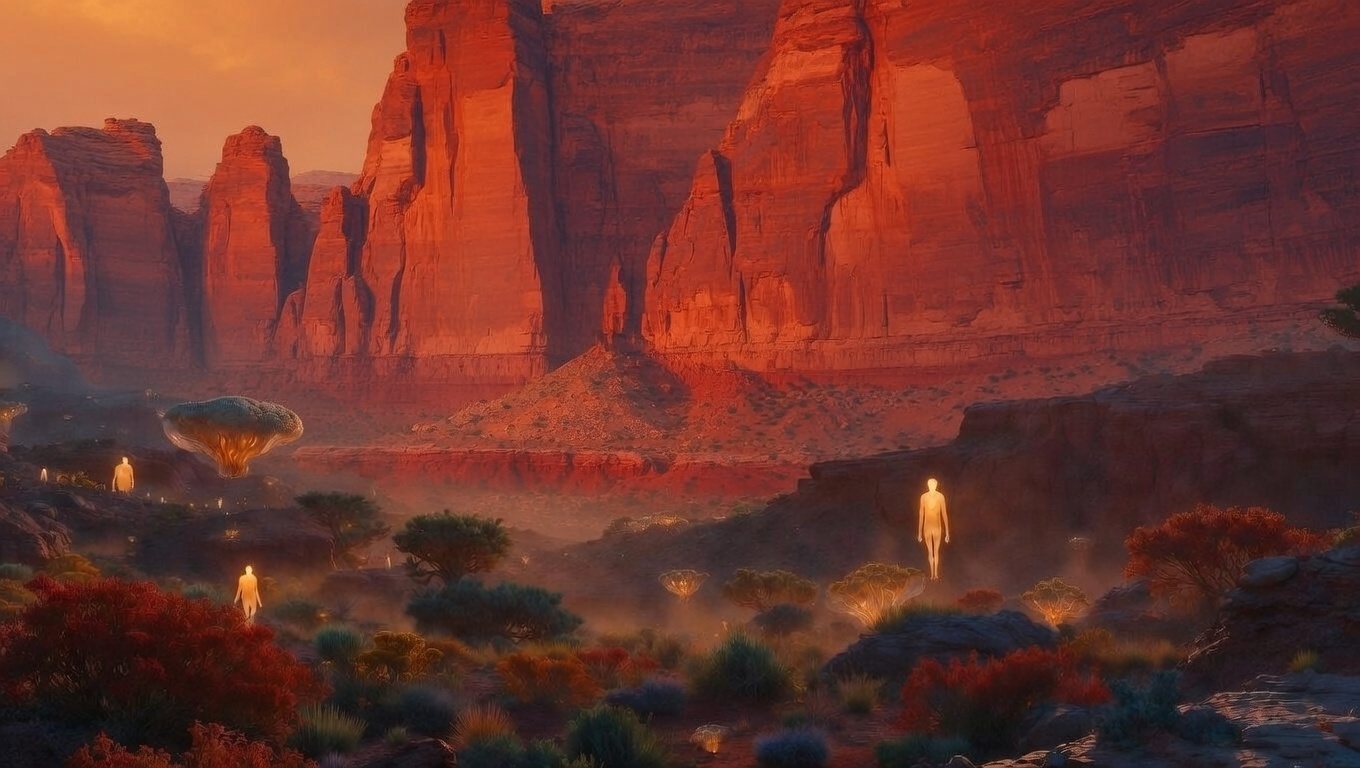
According to the Taygetan perspective, the afterlife is not a fixed destination — it is a direct manifestation of who you are. When you die, your consciousness does not travel to some external realm; it generates its surroundings from its own ideas, attachments, and frequency. There is no single "afterlife" that applies to everyone. A person consumed by guilt may experience torment, while someone at peace may dissolve into a state of pure love and integration. Both experiences are equally real, because in the absence of a physical body, thought manifests immediately.
As for "levels" — the speakers generally reject the idea of rigid afterlife tiers like traditional heaven, purgatory, and hell. However, they do describe a practical spectrum of experience. At one end, souls trapped by trauma or material attachments generate a grim mirror-world of the physical, sometimes called the lower astral. At the other, consciousness expands toward full integration with Source — an experience described as infinite love, omnipotence, and the dissolution of the boundary between self and everything else. Between these poles, every conceivable variant exists, shaped entirely by the individual's beliefs and state of mind at death.
Importantly, the speakers disagree on whether this is encouraging or disturbing. Mari Swaruu emphasises that traumatic experiences are often transmuted into positive growth once you cross over. Yazhi Swaruu counters that disincarnation does not automatically elevate anyone — "Broken Shoes is Broken Shoes whether alive or dead." Za'el frames it as the most empowering truth possible: since you are always Source, your only real option is to grow stronger and wiser.
The Full Picture
The Afterlife as Self-Generated Reality
The foundational principle, agreed upon by all speakers, is that the afterlife is not a place you go — it is a reality you generate. Swaruu of Erra laid this out plainly: when you die, the only thing that remains is your frequency without the physical body. In higher planes, manifestation is immediate. Whatever you believe, expect, or fear becomes your experience. If you believe in Jesus, you find Jesus. If you believe in punishment, you experience punishment. If you believe in the Cosmic Cat, the Cosmic Cat you will find.
This is not metaphor. Swaruu described it from personal memory: at Source, everything is at your fingertips. You are literally an omnipotent being. Everything you think manifests instantly. You understand that it was you, and only you, who created everything — infinite in space and infinite in time. She described the feeling as total love and integration, like a warm blanket in winter. From that state, you dare to incarnate again because you know you cannot get lost. It is only your own game.
Yazhi expanded this into a more radical framework. For her, the higher planes are not "higher" or separate at all — they are the same plane, only more expanded. They are here, mixed in, wherever you are. Living in those planes is like living in your imagination as something totally real. You imagine being on Earth and you are. You switch to Erra in winter and you live it. You imagine cosmic fish among nebulae and that is your reality. You are mind; you only have a body when you imagine one.
Key sources: 062 (Life After Death — Swaruu), 223 (What Happens After Death — Yazhi), 021 (Families and Afterlife — Swaruu)
The Lower Astral — A Dark Mirror of the Living World
While the most expanded afterlife experience is one of love and integration, not everyone reaches that state. Multiple speakers describe what happens to souls who die with heavy attachments, trauma, or confusion.
Swaruu described how a person who dies violently or with extreme attachment to their body may not realise they have died. Because manifestation is immediate on the other side, they generate a copy of the physical world — an astral body, clothes, shoes, the streets of the city where they lived. They walk through this self-created mirror world without knowing they are dead. When they have strong obsessions, they experience the same traumatic situation over and over. Ghosts dragging chains through hallways are souls trapped in these loops.
Over time, groups of these confused souls find each other and form alliances, clans, and families — an entire sub-world that is a slightly distorted copy of the physical. Swaruu called it a caricature of 3D, with strange deformations — bathroom doors too small to pass through, decadent and gloomy versions of familiar streets and buildings.
Mari Swaruu described this lower astral as a dark, twisted interpretation of the material world — where extreme feelings of psychological pain, anger, fear, and guilt trap the soul. She was careful to add that in her view, nobody truly gets permanently lost there. A ghost may be a temporal anomaly or an echo rather than a fully conscious soul in perpetual suffering. But from the experiential perspective of those trapped in it, the suffering is real.
Yazhi gave the most detailed cosmological explanation. She described how a dead person's attachments create mirror streets, buildings, and people. These worlds can be grim and decadent, but equally beautiful and tranquil worlds also form — every variant in between exists. It all depends on the ideas carried at death. The world of the dead mirrors the world of the living because the attachments are the same. The dead don't go somewhere else; they generate a reality from the ideas they cannot let go of.
Key sources: 062 (Life After Death — Swaruu), 224 (World of the Dead vs Living — Yazhi), S-032 (Death and the Ego — Mari)
The Density Framework — 4D as the Buffer Zone
Swaruu of Erra described 4D as the lower astral — a frequency buffer zone between 3D (the artificially suppressed Earth realm) and 5D (normal existence in the wider universe). This is where many of the entities, astral creatures, and confused discarnate souls reside. Creatures there include astral slugs, etheric parasites, and various beings that humans encounter as folklore — elves, trolls, dragons, faeries.
However, every speaker eventually complicated or rejected the density numbering system. Swaruu herself said the numbers are human concepts attempting to classify a continuous gradient. Yazhi went further, rejecting densities, dimensions, timelines, and parallel universes as separate things entirely — they are all ideas within one unified mass of consciousness. There are no fixed levels. You do not live in a density; you are the density, based on your accumulated knowledge and the attachments that define your perception.
This matters for the afterlife because it means the "levels" people experience after death are not external structures imposed on souls. They are self-generated by the ideas each soul carries. A person trapped in fear manifests a 4D-like experience. A person who has done deep inner work may skip the lower astral entirely and experience something closer to Source integration.
Key sources: 007 (Densities — Swaruu), 224 (World of the Dead — Yazhi), 131 (Let's Be Our Higher Self Now — Yazhi)
What Happens Between Lives — The Afterlife Social World
The afterlife is not just a solitary experience. Swaruu described an active social life between incarnations: you meet and recognise loved ones, you discuss what happened during your lives, you manifest bodies and places at will, and you can communicate telepathically or verbally. There is no fixed density — it is a state of absolute freedom. Think of a beach and you are there. Think of pizza and it appears. People with similar interests and frequencies appear near you.
Yazhi's description of soul behaviour in the afterlife adds a layer of complexity. In transcript 354, she explained that in the afterlife, the veil of forgetfulness is much thinner, and souls experience enormous empathy. They share experiences telepathically in ways that go far beyond anything possible during physical life. Katras (the Taygetan term for soul, stripped of religious connotation) merge and fragment based on the ideas they hold. Specific ego identities tend to dissolve on the spiritual side, while incarnation in a physical body is what generates strong ego boundaries.
This means the afterlife is not static. Souls are constantly exchanging ideas, merging with compatible frequencies, fragmenting when they want to pursue contradictory paths, and drawing up plans for future incarnations. The process happens outside any temporal framework — there is no waiting, no queue, no sequence.
Critically, the afterlife also has no fixed authority. There are no judges, no gatekeepers (except those you manifest by expecting them), and no external forces deciding your fate. Swaruu was explicit: there are no archon traps waiting for you. If you find archon traps, it is because you expected to find them. Karma is a belief system, not a law. The only thing that sends a soul back into incarnation is its own unresolved attachments.
Key sources: 021 (Families and Afterlife — Swaruu), 354 (Soul Fragmentation in Afterlife — Yazhi), 025 (Karma — Swaruu)
The Disagreement: Does Death Automatically Elevate You?
This is one of the most important tensions in the material, and the speakers handle it differently.
Mari Swaruu emphasised the positive transmutation that occurs at death. Drawing on her own past-life memory of dying in a rock-climbing fall, she described how the terror of falling transformed into euphoria once she crossed over. She noted that enemies in life become friends in the spirit world, that material possessions lose all meaning, and that even traumatic experiences are reinterpreted as valuable growth. From the spirit side, an entire incarnation looks like a temporary ride. Her concern was that this transmutation may undermine decisions made while alive — including the decision not to reincarnate.
Yazhi Swaruu pushed back against the idea that disincarnation automatically improves your state. She stated directly that your higher self is not necessarily that high. The afterlife does not mean elevated understanding. Souls go to a level matching their frequency and development. They take the Matrix with them when they die. Someone trapped in limiting ideas will plan their next life from a limited viewpoint. Being embodied or not is irrelevant to consciousness level. "Broken Shoes is Broken Shoes whether alive or dead" — you do not automatically return to pure Source.
Athena Swaruu (Swaruu X) described consciousness expansion after death using a measuring tape analogy. In life, a person might have awareness spanning from "centimetre 42 to 52." After death, that awareness might expand to cover "-2026 to 2982" — a mind-boggling expansion. But it is still not Source. Limitation still exists, just at a vastly greater range. The veil of forgetfulness remains even after death, just much reduced. It must exist for individuality to persist.
Za'el offered the most direct framing: wherever your ideas take you. He described cases where consciousness jumps directly from one life to another without any intermediate afterlife at all — dying as Paul and immediately becoming Gabe at a moment where Gabe feels the same emotions Paul died with. For Za'el, the empowering message is that your only option is to grow stronger, because you cannot escape yourself. You are your own Matrix.
Key sources: S-031 (Same Events Different Meanings — Mari), 131 (Higher Self Now — Yazhi), 184 (Is There a Soul — Athena), Z-009 (Where Do We Go When We Die — Za'el)
Death as Integration, Not Destruction
Despite their disagreements on the details, all speakers converge on one point: death is not destruction. Yazhi described it as integration — the dissolution of the I and Ego back into the etheric field. From the perspective of someone alive, this sounds terrifying. But from the other side, it is pure love. What seems like the annihilation of the self is actually the reconnection to everything. This is precisely what near-death experiencers describe: being surrounded by unconditional love, regretting having to return to their body.
Yazhi was careful to note that this does not mean the self is destroyed. The ideas and attachments that formed your identity existed before your incarnation and continue to exist after it. Death is only the resolution of a particular sequence of ideas. It cannot exist from one's own point of view — it is only real in the minds of the living.
Mari echoed this: we are not given a soul, and we do not have a soul — we are a soul. We are building it as we go along. Experience and how we interpret it is what matters. Heaven and hell are not places we are sent to; they are reflections of who we are. We create both.
Key sources: 223 (Higher Planes — Yazhi), S-032 (Death and the Ego — Mari), S-021 (Your Body and Death — Mari)
Practical Implications: Talking to the Dead
Swaruu offered concrete practical advice about interacting with the deceased. The dead listen — they attend their own funerals and closely follow loved ones. Speaking to them aloud works best, because many discarnate souls have not developed telepathic reception. Rather than praying religious mantras (which can reinforce limiting beliefs), Swaruu recommended telling the deceased that they are free and forgiven for whatever they think they did wrong. This, she said, is how you free someone from karma.
She also warned about cemeteries: more souls congregate there, and when you leave, you should order them not to follow you. Children should never be taken to cemeteries because their undeveloped auras make them vulnerable to attachment by envious discarnate beings who are jealous of their vitality.
Key sources: 062 (Life After Death — Swaruu), 063 (Death and Afterlife More Questions — Swaruu)
Evolution of Understanding Across Speakers
| Speaker | Core Position | Distinctive Emphasis |
|---------|--------------|---------------------|
| Swaruu (9) | Afterlife = Source; you see what your frequency dictates; law of mirrors governs everything | Practical detail — cemetery warnings, talking to dead, social life between lives |
| Yazhi Swaruu | No material world, no spirit world — one unified mass; afterlife is just less-filtered perception of what always was | Dissolution of self = love, not destruction; rejects density gradients; "bubbles" model |
| Athena Swaruu (X) | Soul = self-limitation of Source defined by memory; expansion after death is real but still limited | Measuring tape analogy; veil persists even after death; expansion ≠ omniscience |
| Mari Swaruu | Traumatic events transmuted to positive on spirit side; soul is built not given; heaven/hell = who you are | Personal past-life death memory; concern about spirit-side decisions overriding earthly ones |
| Za'el | Wherever your ideas take you; sometimes no afterlife at all — direct jump between lives | Paul-to-Gabe direct incarnation; empowerment framing; inner child metaphor |
Key Transcript References
| # | Title | Focus |
|---|-------|-------|
| 007 | Densities | 4D as lower astral buffer zone; density spectrum from 1D minerals to 7D pure consciousness |
| 021 | Families and Afterlife | Afterlife social life; instant manifestation; soul groups; Source state described |
| 062 | Life After Death: Where Do We Go When We Die? | Law of mirrors; lower astral world generation; talking to the dead; cemetery warnings |
| 063 | Death and Afterlife: More Questions | 5D afterlife; low vs high astral; near-death cultural variation; deceased children |
| 131 | Let's Be Our Higher Self Now | Higher self not automatically elevated; disincarnation doesn't remove Matrix; Broken Shoes metaphor |
| 184 | Is There a Soul? What Is It? | Soul as self-limitation of Source; measuring tape analogy; consciousness expansion after death |
| 190 | Singularity — Consciousness | Death as cosmic impossibility; afterlife manifestation of belief systems |
| 223 | What Happens After Death? Higher Planes | Yazhi on living in imagination as reality; death as integration not destruction; veil as frequency incompatibility |
| 224 | There Is No Material World Part 2 | World of the dead mirrors living world; bubbles of consciousness; no densities as external places |
| 354 | How Do Souls Fragment in the Afterlife? | Katra defined; afterlife merging/fragmenting; enormous empathy dissolves ego boundaries |
| 386 | Astral World — Soldiers in the Astral | Astral and physical mutually generated; animals in astral; astral warfare; entity feeding dynamics |
| Z-009 | Where Do We Go When We Die | Wherever your ideas take you; Paul-to-Gabe direct incarnation; Source as engine of consciousness |
| S-021 | Escape the Matrix 3: Your Body and Death | No material world; body as physical expression of etheric identity; love as integration |
| S-031 | Same Events, Different Meanings | Spirit-side reinterpretation of trauma; rock-climbing death memory; incarnation as temporary ride |
| S-032 | Death and the Ego | Ego formation and death; lower astral as self-trap; soul-building as purpose; dual outcomes |