Primary Theme: Extraterrestrial Races
Additional Themes: Biology, Genetics & Health · Consciousness, Soul & the Nature of Self · Galactic Federation & Exopolitics
Sources: 5 transcripts, 3 speakers (Swaruu 9, Arishah/Urmah, Mari Swaruu)
Transcripts: 107, 128, 104, S-194, 321
Short Answer
The Arcturians are three closely related ancient species — the Dieslientiplex, the Devonians, and the Korendians — who inhabit countless planets in the region of Boötes, often called the Void because it has fewer stars than surrounding areas. They are non-Lyrian, meaning they did not originate from the Lyrian expansion that produced human-type species like Taygetans, Engans, and Earth humans. They are described as having "high amphibian DNA content" and are more closely related to the Andromedans and the Celeano (Blue Pleiadians) than to any humanoid species (107).
They are not hybridised in the sense of being artificially constructed from other races. They are a Primary species — extremely ancient, self-generating through a unique form of asexual reproduction, and continuous in individual consciousness across what amounts to an eternal lifetime. Their biology, consciousness, and social structure are fundamentally different from anything in the Lyrian family, and they are consistently described as among the most advanced races in the galaxy both technologically and spiritually.
Three Species, One Cultural Family
Swaruu identifies the Arcturians as three distinct but closely related species rather than one: Dieslientiplex, Devonians, and Korendians. They share a common region (Boötes), common biology, common culture, and a common approach to existence, but they are named and recognised as three separate branches (107).
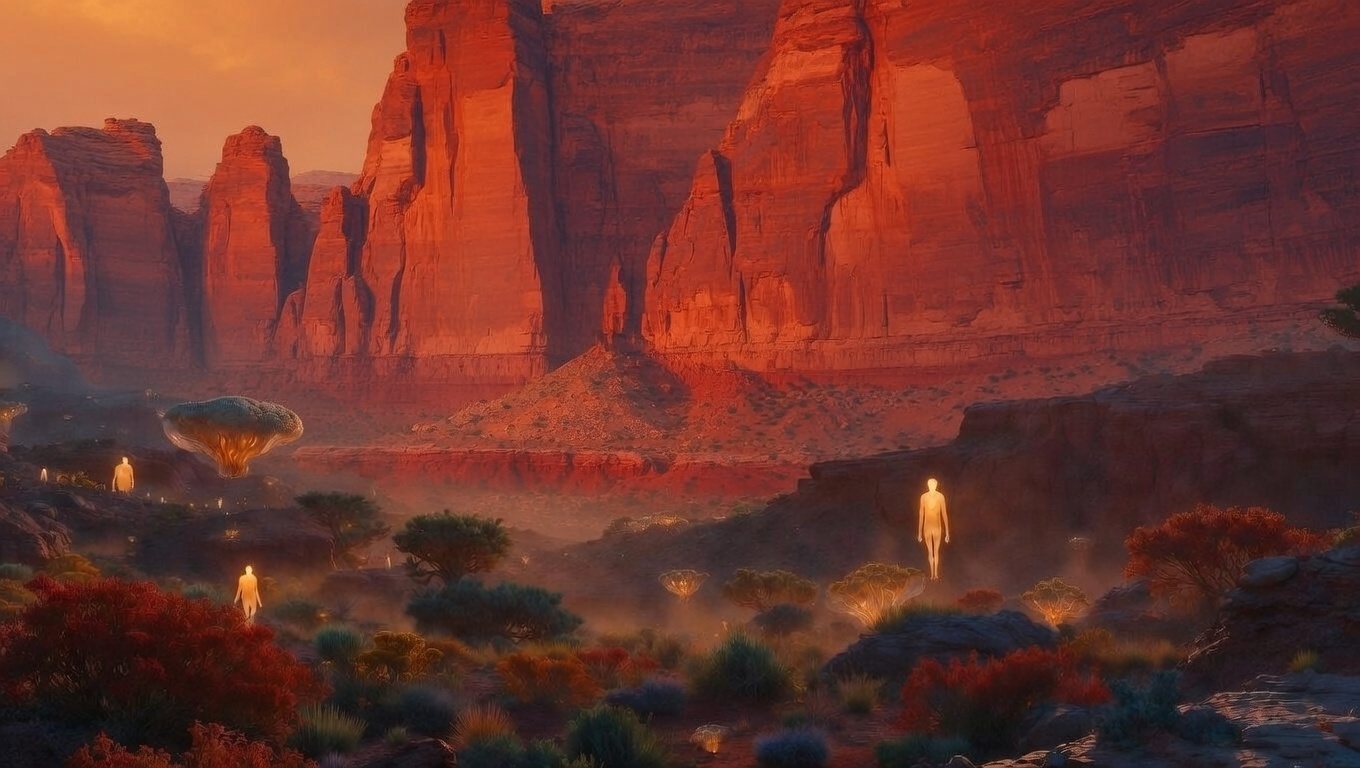
Their space region is described as full of swamps across countless planets. Despite being called the Void from a human perspective — because it has a lower star density than other areas — it is far from empty. The Arcturians have turned it into the galaxy's premier shipbuilding centre. Swaruu calls it "Space Detroit" — the location of major dry docks where ships are constructed and traded for other technology or raw materials. Freighter traffic in and out of the Boötes region is described as constant and heavy (107).
Their relationship with the Andromedans is particularly close. The Andromedan ships — including the massive biosphere vessels — are constructed in or near the Boötes region, specifically on or near the planet Pitoya, under the control of the Dieslientiplex Arcturians (128). This long-standing manufacturing partnership makes the Arcturians and Andromedans deeply interdependent, despite being biologically and temperamentally very different races.
Physical Appearance and Biology
Arcturians are short — rarely exceeding 150 centimetres, with an average height of 130 to 140 centimetres. They have large heads disproportionate to body size, large almond-shaped eyes, and large mouths. Despite these features, Swaruu describes them as "very beautiful aesthetically speaking." Their skin comes in various colours from brown to purple, often with brown or red spots (107).
They are not gendered. There are no males or females — all Arcturians are one sex. Their reproduction is asexual but distinct from Taygetan parthenogenesis. In the belly they have a pouch comparable to that of marsupials. When an individual becomes old or physically damaged, a new being begins forming in this pouch — an identical clone. When the clone reaches sufficient size and maturity, it emerges as a small being, "as a small kangaroo would" (107).
The critical feature of this reproduction is the consciousness transfer. As the new body matures, the progenitor's awareness passes into the small creature. When the process completes, the individual leaves the old body entirely and inhabits the new one, "leaving the larger body to die for lack of consciousness attention." The newborn is fully independent — "100% capable of surviving and taking care of itself" — and continues its life exactly where the previous body left off (107).
This means Arcturians do not truly die. They do not return to Source to reincarnate unless killed by accident. They simply renew themselves indefinitely, self-cloning across an eternal continuous lifetime. Where Taygetans and humans remember past incarnations as separate lives, an Arcturian sees its existence as "an eternal line from a remote past being the same being with total memory of that. Progression and direct accumulation of memory and knowledge" (107).
When asked how old they are, Swaruu deflects: "Once again, age sharing is only a reference for understanding. Here and with them, time is not a factor, they just are" (107).
Consciousness and the Question of Ascension
The Arcturians' relationship with consciousness and density is distinctive. They are 100% aware — no veil of forgetfulness, total memory of their entire existence. "They forget whatever they decide to forget" (107).
Despite maintaining physical 5D bodies, they consider themselves fully ascended. Swaruu explains their philosophy: "They do not think that having a 5D material body is an impediment to being fully ascended and advanced in all senses. They see it as complementary, not as one thing or the other. The body is not something to transcend, it is something to include in the whole" (107). Swaruu explicitly endorses this perspective: "I not only agree with this, I intend to share it."
All Arcturians are highly connected telepathically. While this could be interpreted as hive mind, it is explicitly not — "each one is different, with their own personality and it is even known that they can argue with each other." They are "mostly logical, but can be highly temperamental" (107). The collective is unified but not homogenised.
New individuals can be generated when one Arcturian produces multiple descendants — the clones are technically the same person as the original, but over time develop their own distinct identities while remaining deeply connected to the whole. The result is described as something that "can be interpreted as the same collective individual" — a paradox that sits between individual and hive, resolved by the Arcturians themselves through their own experience of it (107).
Culture and Creativity
Arcturians are described as "highly creative in all aspects" — art, music, and engineering. They wear elaborate clothing: "long one-pieces, ultra ornamented with gold and silver spirals, usually dark metallic red, violet and blue" (107).
They have no concept of romantic love — no couples, no gendered relationships. When asked whether this makes them cold, Swaruu distinguishes: "They have the concept of love but it is different, not as romantic love of a couple, rather as love in totality" (107). They understand romantic love through studying other species but find the human and Taygetan approach to reproduction "strange and awkward, apparatus-focused" — and make fun of it (107).
The Arcturians are also the primary creators of crop circles. Of the complex formations that are genuinely non-human in origin, Arcturians are the most prolific producers, alongside contributions from Antarians, Dieslientiplex, Centauri, and Taygetans (321). The fractal geometry of Arcturian visual patterns — whether in crop circles or in art shared through channelled images — reflects their mathematical sophistication. Swaruu describes studying one such image and seeing "countless things — people, energy signals from people, as individual seals of dynamic energy... objects and energy flow being vital energy of Chi or electromagnetic and gravitational energy. All obey the advanced fractal geometry patterns" (107).
Political Position and the Service-to-Others Debate
Arcturians are Federation members and co-founders of the Andromeda Council, as well as members of the Sphere Alliance. They have been present near Earth since approximately 1947 (107).
Their political philosophy emphasises total service-to-others as a governing principle. This is shared with the Andromedans and represents one of the dominant ideological frameworks in the Federation. However, the Urmah explicitly reject this approach. Arishah (an Urmah representative) states that the Arcturians and Andromedans "even condemn any service-to-self activity, or even thoughts of their people, claiming that it leads to becoming regressive, claiming that it leads to the dark side." The Urmah see this as problematic: it "leads to developing strong feelings of inadequacy and even guilt, simply because one or another of their members wants to fulfill their own path while being alive, as if they did not have the right" (S-194).
The Urmah alternative — teaching cubs to pursue personal development while understanding interconnection — contrasts with the Arcturian model where collective duty is placed above individual expression. This philosophical difference is one of the major fault lines in Federation politics and reflects the broader tension between non-Lyrian logical races (Arcturians, Andromedans) and Lyrian emotional races (Taygetans, Urmah, humans).
Despite this ideological difference, the relationship between Taygetans and Arcturians is described as one of "mutual cooperation, very friendly" (107). Swaruu personally expresses a tendency to agree more with the Arcturians than with the Federation mainstream: "It is closer to my perspective, not so much of the Federation's. I have a tendency to agree more with the Arcturians, although not in everything" (107).
Were They Always This Way?
The original question asks whether the Arcturians were always hybridised or were a different race before. The material's answer is that the Arcturians are not hybridised at all — they are a distinct Primary species. Their "high amphibian DNA content" is not the result of hybridisation between two parent species but rather reflects their nature as a non-Lyrian lineage that developed along fundamentally different biological principles from the humanoid races.
Their three sub-species (Dieslientiplex, Devonians, Korendians) represent natural variation within one family, not hybridisation products. Their self-cloning reproduction — which avoids the mixing of genetic material that characterises sexual reproduction — actually makes them less susceptible to hybridisation than almost any other species. Each individual is a continuous, self-renewing genetic line, untouched by the recombination that produces variation in sexually reproducing species.
In the framework established elsewhere in the material, the Arcturians would be classified as Primary species — those whose origins are "lost in the eternity of non-linear time" and who manifested from higher planes rather than being created or modified by other races. They are, by all accounts, exactly what they have always been.
Evolution Across Speakers
Swaruu of Erra (2020) provides the comprehensive biological, cultural, and political description of the Arcturians: three species, non-Lyrian, amphibian DNA, Boötes region, short stature, marsupial-pouch self-cloning, consciousness transfer, eternal individual continuity, no gender, no romantic love, creative and mathematical, Federation co-founders, crop circle creators, friendly with Taygeta.
Arishah the Urmah (2024) provides the critical external perspective: the Arcturians' service-to-others philosophy, while well-intentioned, is seen by the Urmah as potentially oppressive — condemning self-interest creates guilt and inadequacy rather than genuine altruism.
Mari Swaruu (2024) references Arcturians peripherally in the context of species diversity across densities — individuals of any race, including Arcturians, can dwell in lighter or heavier existential realms depending on their consciousness level, reinforcing that the Arcturian three-species family is not monolithic in experience (S-270).
Key Transcript References
- 107 — Primary Arcturian transcript: three species (Dieslientiplex / Devonians / Korendians), non-Lyrian with high amphibian DNA, related to Andromedans and Celeano, Boötes region ("Space Detroit" — swamp planets, major shipbuilding dry docks, heavy freighter traffic), physical appearance (130-150cm, large heads, almond eyes, large mouth, brown to purple skin with spots — "very beautiful"), one sex only (no males/females — mock human reproduction as "apparatus-focused"), marsupial-pouch self-cloning (consciousness transfer from old body to new — newborn 100% independent — never truly die — "eternal line from a remote past" — total memory), highly creative (art, music, engineering — elaborate clothing with gold/silver spirals), crop circles (most prolific non-human creators — complex fractal geometry), politically: Federation members, Andromeda Council and Sphere Alliance co-founders, present near Earth since ~1947, "mutual cooperation" with Taygeta, Swaruu agrees more with Arcturians than Federation mainstream
- 128 — Andromedan-Arcturian partnership: Andromedan ships constructed near planet Pitoya in Boötes under Dieslientiplex control, Arcturians as closest friends of Andromedans for millennia
- 104 — Arcturians listed among major races in Federation context (Dieslientiplex named alongside Andromedans in race introduction)
- S-194 — Urmah critique: Arcturians and Andromedans impose service-to-others mentality on citizens, condemn self-interest as regressive, Urmah reject this as leading to inadequacy/guilt, Urmah alternative teaches personal development alongside interconnection awareness
- 321 — Crop circles: Arcturians (including Dieslientiplex specifically) among primary creators of complex crop formations, alongside Antarians, Centauri, and Taygetans