Short Answer
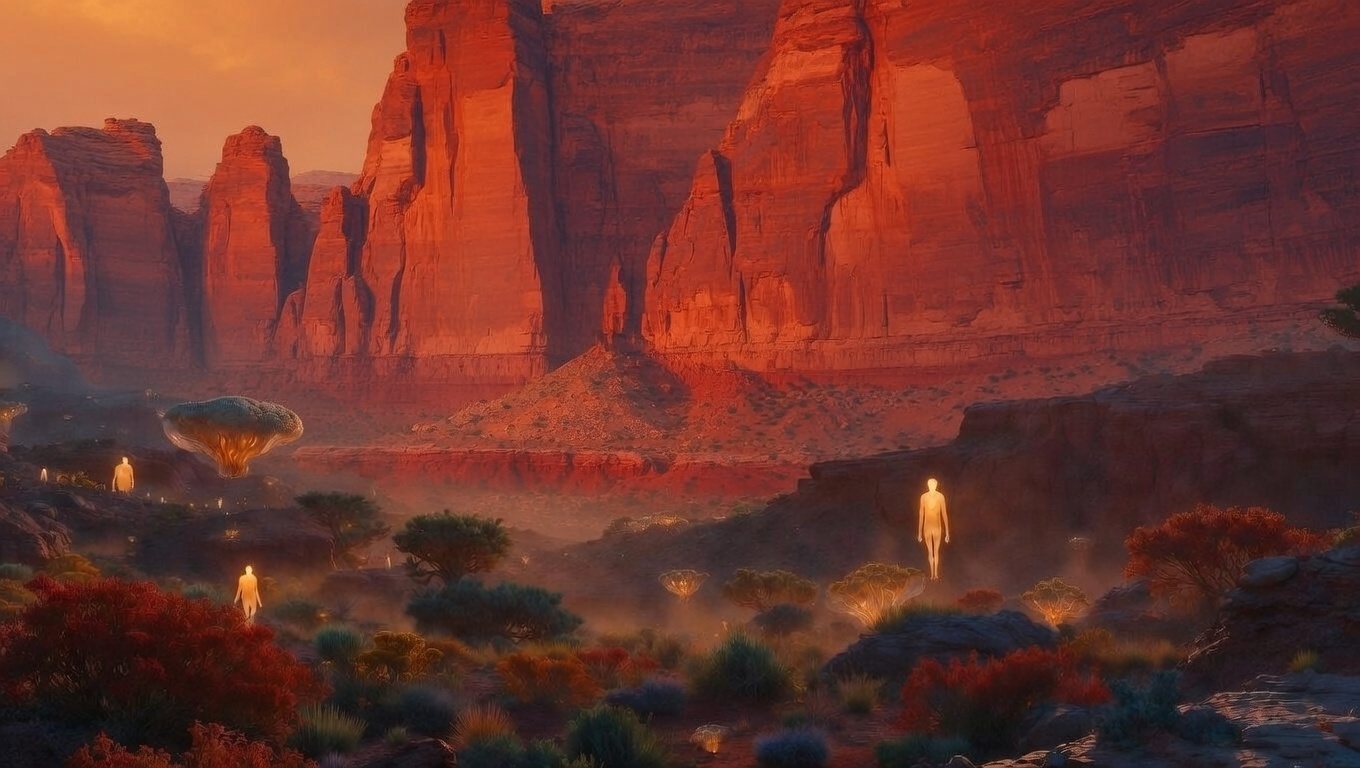
The tunnel of light is not a universal phenomenon and it is not a trap. According to the Cosmic Agency material, what a person sees at death is a direct manifestation of their own beliefs, expectations, and frequency. Swaruu 9 states in transcript 062 that when you die you see what you wish to see, because in higher planes everything manifests immediately. There can be no archon traps waiting to force souls to reincarnate — that is only found because that is what they expect to see.
The tunnel of light specifically is a Western cultural phenomenon. Swaruu 9 notes in transcript 063 that near-death experience researchers have found the classical tunnel of light is seen nearly exclusively in the West. In Japanese culture, the near-death experiencer finds a river and must cross it. In African cultures, the person waits for relatives to come for them. The visitation of deceased relatives is the only element that appears consistently across all cultures — and even that manifests differently depending on cultural expectations.
Yazhi Swaruu provides the most direct reframing of the light experience in transcript 223: what many people with near-death experiences describe as being surrounded by pure love is actually the dissolution of the ego back into the unified field. From the perspective of someone alive, this dissolution looks like destruction — and that is terrifying. But from the other side, it is integration, unconditional acceptance, and a love so complete that those who experience it regret returning to their bodies. The light is not bait in a trap. It is the natural experience of a consciousness expanding beyond the limitations of the body.
The Full Picture
What Near-Death Experiencers Actually Report
The Cosmic Agency material draws on the same body of near-death experience research available on Earth — particularly the work of Dolores Cannon — but interprets it through a fundamentally different framework. Rather than treating NDE reports as descriptions of an objective afterlife landscape that everyone will encounter, the speakers treat them as evidence that each person's afterlife is a unique manifestation of their own consciousness.
Swaruu 9 provides the clearest statement of this principle in transcript 062: when a person dies, they will see and experience exactly what they expect to see. If someone believes in Jesus, Jesus they will find. If they believe in Allah, Allah they will find. If they believe in Cosmic Cat, the cat they will find. This is not a defect in the system or evidence of manipulation. It is how consciousness works at every level — you perceive what your frequency allows you to perceive, and in the higher planes where manifestation is immediate, your beliefs become your experienced reality without delay.
Transcript 063 adds empirical weight to this claim by noting that leading NDE researchers have documented dramatic cultural variation in death experiences. The tunnel of light — far from being a universal feature of dying — is a culturally specific phenomenon. The Japanese experience a river. African cultures experience a waiting period for ancestral escorts. What remains constant is only the broad principle: deceased relatives appear, and the experience reflects the dying person's cultural framework. Even the relatives who appear are shaped by expectation — they comfort, they guide, and they promise to make the transition easier, but the form this takes is culturally determined.
Mari Swaruu addresses NDE reports from a different angle in S-253. She notes that many near-death experiencers say the other side is as physical as this side of the living. Rather than taking this as evidence of an objective spirit world with physical properties, Mari interprets it as a reflection of the experiencer's attachment to material existence. People who are deeply identified with their bodies will manifest a material-seeming afterlife because that is what their consciousness knows how to create. The NDE report is not a map of the afterlife — it is a mirror of the experiencer's state of consciousness.
The Light as Integration, Not Lure
Yazhi Swaruu provides what may be the most important reframing of the light phenomenon in transcript 223. She describes what happens at death as a dissolution of the ego back into the unified etheric field. The experience of being enveloped in overwhelming love and light — the signature feature of positive NDEs — is this dissolution experienced from the inside.
From the perspective of someone alive, the dissolution of the self sounds like annihilation. The ego, built through a lifetime of attachments to identity, relationships, and the body itself, interprets its own dissolution as destruction. This is why death is feared. But from the other side, Yazhi says, what you interpret here as destruction, there it is integration, and a great love that invades you. You swim in pure love, in unconditional acceptance.
The light, in this framework, is not something external that appears to the dying person. It is the person's own nature — their connection to Source, which was always present but filtered out by the body's narrow perceptual bandwidth. When the body fails and that filter is removed, the consciousness expands and begins to perceive its own fundamental nature, which is Source itself. The experience of light and love is the experience of remembering what you actually are.
This is why those who return from near-death experiences overwhelmingly report that they did not want to come back. They were not being seduced by a trap. They were experiencing the removal of limitation — and the return to limitation felt like loss.
The Soul Trap Question
The idea that archonic beings have installed machines or energy devices to trap souls at death and force them into reincarnation is addressed most directly by Athena Swaruu in transcript 286. Her response is unequivocal: a machine as responsible for the veil of forgetfulness cannot exist, because forgetting is an intrinsic part of the making of a soul. You cannot trap a soul because there is nothing to trap — it is Source itself.
Athena explains the logic carefully. A soul is not an object that can be contained. It is a group of ideas held by Source — a point of attention within the infinite. The only way to trap such a thing is to convince it that it is trapped. The basic soul trap as such at death, the classic one referring to forced reincarnation, does not occur as with a machine much less with a devil holding a pitchfork. It is the basic ideas of the soul-ego-self itself that make it want to reincarnate.
Swaruu 9 makes the same point from a different angle in an earlier conversation included in transcript 286. Having a soul captive is not literal like having a bird imprisoned in a cage. Having it captive is like having a person captivated by a television program. The soul is there watching because it is interested. If it loses interest or looks at something else, it simply leaves. The regressive entities who attempt to hold souls in frequency containers lose them constantly because as soon as the soul realises it is captive, it withdraws.
What about the Van Allen belts? This comes up in transcript 063, where Robert asks how a soul crosses them after death. Swaruu 9's answer is straightforward: people thinking in 3D mentality will automatically be under that frequency, but the ones who are awake will have the intention to go, and that is a higher frequency, enough to leave the Earth. The Van Allen belt generators may function as frequency enhancers that make Earth's low-frequency environment more pronounced — Athena acknowledges this possibility in 286 — but they are not soul traps. A soul with sufficient awareness simply rises above the frequency range they operate in.
What Actually Causes Reincarnation
If there are no soul trap machines, why do so many souls reincarnate into Earth's difficult conditions? The material's answer is consistent across all speakers: belief systems.
Swaruu 9 explains in transcript 062 that a soul caught in religious belief will die, see Jesus (or whatever religious figure matches their belief), be told it must return to pay karma, and re-enter — hundreds of times, thousands maybe — until on its own, that soul understands that it is only it who is generating everything. The cycle is not imposed from outside. It is self-generated through belief, and it can only be broken by the soul's own realisation.
Mari Swaruu develops this extensively in S-235, addressing the question of forced reincarnation directly. Her answer: there is forced reincarnation for some souls and not for others. It depends entirely on the ideas the soul holds, especially at the time of death. When a person dies, all that remains is their ideas — and ideas are vibrations, and vibrations manifest into things, circumstances, and events. A soul that believes in karmic debt will manifest karmic judges. A soul that believes in archonic traps will manifest archonic traps. A soul that understands its own nature as Source will manifest accordingly.
However, Mari adds a critical second layer: the controllers of Earth deliberately manipulate the belief systems of the living population to ensure that most souls die holding beliefs that will cause them to reincarnate. Religion, scientific materialism, fear of death, the concept of karma — all of these are, in this framework, engineered belief systems designed to produce specific afterlife behaviours. From this angle, forced reincarnation is real — not because of machines, but because of systematic perception manipulation that shapes what people believe and therefore what they manifest at death.
S-032 adds the psychological dimension. Mari describes how extreme feelings of psychological pain, strong attachment to the material world, and especially anger, fear, and guilt trap the soul in the lower astral — not through external force but through the soul's own inability to let go of its ego identity. The soul that dies with unresolved psychological pain takes that pain into the afterlife and, finding it cannot resolve material-world problems from the spirit side, feels compelled to reincarnate into circumstances that might allow resolution.
The Veil of Forgetfulness: Frequency, Not Technology
Both Athena and Yazhi address the mechanism of the veil of forgetfulness — the memory loss that accompanies incarnation — and both reject the machine hypothesis. Yazhi states in transcript 286 that the veil obeys something very simple: it is the same mechanism that erases dreams when you wake up. Memories from higher-frequency planes are not compatible with the lower-frequency environment of Earth. The brain, which translates etheric signals into material-world experience, simply cannot decode frequencies that are too far outside its operating range.
Mari reinforces this in S-235: the veil exists everywhere, not only on Earth. It is less marked outside Earth's environment, but it depends more on who you are than on where you are. Some people on Earth remember past lives. Some people in space do not. The veil is a natural consequence of frequency disparity between realms, not a technology imposed by controllers.
This has direct implications for the tunnel of light question. If the veil is a frequency phenomenon rather than an imposed technology, then the entire framework of soul traps, memory-wipe machines, and forced reincarnation through external devices collapses. What remains is the simpler and more empowering explanation: your afterlife experience is generated by your own consciousness, and the only thing that determines what you encounter at death is who you are.
How to Navigate Death Consciously
If the afterlife is a manifestation of one's own consciousness, then preparation for death is preparation of consciousness. Several speakers address this directly.
Swaruu 9 offers practical advice in transcript 062: talk to the dead. Tell them they are free and forgiven for whatever they have done. This is freeing karma — not the cosmic accounting system, but the psychological attachments that keep souls cycling through the same patterns.
Mari addresses preparation for death most extensively in S-159, where she introduces the concept of Mahasamadhi — the state described in Eastern traditions as true liberation from the reincarnation cycle. Mahasamadhi is achieved when the soul leaves the body after realising that it has been a prisoner to all the illusions of being in physicality. It is not a technique but a state of consciousness: complete absorption into one's true cosmic nature as Source.
The practical implication across all speakers is the same: what you experience at death is the direct reflection of the vibration you hold throughout your life. The preparation is not a deathbed ritual but a lifelong practice of expanding consciousness, releasing attachments, and understanding that you are Source. As Mari states in S-159: who we are now today will determine who we will be in the afterlife, where we will go, and into whom we will reincarnate, if at all.
Za'el of Erra summarises the position with characteristic directness in Z-009: where do we go when we die? Wherever your ideas take you. There is no immovable paradise or hell that is the same for everyone. You manifest your afterlife based on how you think it works. Your only alternative and the best alternative of all will always be to move on, to rise again, become strong, take a deep breath, stand up, and learn. Escaping by going to the Source is not an option — you are already the Source.
Evolution of Understanding Across Speakers
Swaruu of Erra (Swaruu 9) provides the foundational framework in transcripts 062 and 063: the afterlife is governed by the law of mirrors — you see what your frequency dictates. There are no archon traps; souls find traps only because they expect to find them. The tunnel of light is culturally specific to the West. Karma is a religious belief, not a cosmic law. Funeral prayers function as mantras that can help or hinder the dead depending on content. Practical advice: talk to the dead, tell them they are free.
Yazhi Swaruu reframes the light experience in transcripts 223 and 224: the NDE experience of overwhelming love IS the dissolution of the ego back into the unified field. What the living interpret as destruction, the dead experience as integration. The veil of forgetfulness is frequency incompatibility, not a machine — the same mechanism that erases dreams upon waking. There is no material world or spirit world — only consciousness manifesting through different lenses of perception. The world of the dead and the world of the living overlap; there are no boundaries other than those generated by ideas.
Athena Swaruu directly debunks soul trap machines in transcript 286: a soul cannot be trapped because it is Source itself. The only trap is the one the soul-ego-self imposes through its own belief systems. The classic forced reincarnation scenario does not occur through machines or devils — it is self-imposed. People take the Matrix with them when they die because the Matrix is their ideas. Van Allen belt generators may worsen amnesia but do not constitute a soul trap. The only true technological soul containment is the immersion pod.
Mari Swaruu develops the psychological and practical dimensions across S-032, S-043, S-050, S-159, S-235, and S-253: fear of death is the natural result of ego attachment; NDE experiencers who report the other side as physical are reflecting their attachment to material existence; no one can escape the Matrix because each person IS their Matrix; Mahasamadhi is the path to true liberation; forced reincarnation exists for some and not others depending on belief systems; the controllers manipulate beliefs to produce reincarnation-causing thought patterns; the veil of forgetfulness exists everywhere and is caused by frequency disparity.
Za'el of Erra provides the complementary perspective in Z-009: wherever your ideas take you — that is the answer. No fixed paradise or hell exists. A soul's consciousness is redirected to where its vibration makes it compatible. It is possible to skip the between-life entirely and move directly into the next incarnation. You cannot escape Source because you are Source. The only option is to become strong, wise, and self-directed.
Key Transcript References
| Transcript | Speaker(s) | Key Contribution |
|---|---|---|
| 062 | Swaruu of Erra (9) | Afterlife governed by law of mirrors — you see what your frequency dictates; no archon traps — found only because expected; karma is religious belief forcing return; heaven/hell generated by guilt and belief; talk to dead to free them; funeral prayers as mantras; cemeteries and the disembodied |
| 063 | Swaruu of Erra (9) | Tunnel of light nearly exclusively Western; Japanese NDE = river crossing; African NDE = waiting for relatives; relative visitation constant across cultures; Van Allen bands crossed by frequency — higher awareness = higher frequency; 5D afterlife with attachments similar to Earth's; dead children carry old soul attachments |
| 223 | Yazhi Swaruu | NDE love experience IS dissolution of ego into unified field; destruction of self from living side = integration from dead side; veil of forgetfulness is frequency incompatibility not machine — same as dream erasure; higher planes are not higher, only more expanded; near-death pure love = reconnection with what you always were |
| 224 | Yazhi Swaruu | No material world — everything is consciousness in one mass; world of dead = mirror of living, formed by attachments of disembodied; no densities, timelines, or parallel universes as separate realms — only perception bubbles; death only exists in minds of living; ghosts and entities result from overlapping perception agreements |
| 286 | Athena Swaruu, Swaruu 9, Yazhi | Soul trap machines cannot exist — forgetting is intrinsic to soul formation; soul is Source, cannot be trapped; only trap is self-imposed through belief systems; classic forced reincarnation does not occur through machines; people take Matrix with them at death; Van Allen generators may worsen amnesia but are not soul traps; immersion pod is only true technological containment |
| S-032 | Mari Swaruu | Body locks consciousness creating ego identity and fear of death; NDE changes mindset; psychological problems follow soul to afterlife; anger, fear, guilt trap soul in lower astral; ghost may be temporal anomaly; we create our heaven and hell — not places we're sent to |
| S-043 | Mari Swaruu | NDE reports of wanting to return for more experience; suffering seen as growth opportunity from spirit side; suicide brings all psychological pain to afterlife; no one can escape Matrix because each person IS their Matrix; Matrix extends beyond Earth into higher realms |
| S-050 | Mari Swaruu | Death is predator with no teeth; NDE and past-life evidence for consciousness continuity; memory not in brain but etheric field; body as frequency filter for narrow bandwidth; DNA as soul-tuned receptor |
| S-159 | Mari Swaruu | Prison planet perspective validated but depends on interpretation; NDE reports that life is learning game; Mahasamadhi as true escape from reincarnation cycle; afterlife = mirror of vibration held during life; preparation for death is lifelong consciousness work |
| S-235 | Mari Swaruu | Veil of forgetfulness exists everywhere — frequency disparity not technology; forced reincarnation: yes for some, no for others — depends on belief systems; controllers manipulate perception to produce reincarnation-causing beliefs; power to refuse forced reincarnation lies within each soul |
| S-253 | Mari Swaruu | NDE reports of physical other side reflect attachment to body identity; everything is astral — no material world; no separation between spirit and material realms; focus on material creates material-like afterlife; consciousness level determines NDE interpretation |
| Z-009 | Za'el of Erra | Wherever your ideas take you — the answer to where we go; no fixed paradise or hell; afterlife manifested by each soul individually; possible to skip between-life entirely; cannot escape Source because you ARE Source; opposing views are complementary not contradictory |